


















        ---------------------------------------
        |                                     |
        |    The Making of the Atomic Bomb    |
        |          Richard Rhodes             |
        |                                     |
        |-------------------------------------|
        |                                     |
        |    Created:           08/16/2007    |
        |                                     |
        |    Last modified:     08/17/2007    |
        |                                     |
        ---------------------------------------
We must be curious to learn how such a set of objects - hundreds
of power plants, thousands of bombs, tens of thousands of people
massed in national establishments -- can be traced back to a
few people sitting at laboratory benches discussing the peculiar
behaviour of one type of atom.
Spencer R. Weart
The atomic bomb and the subsequent hydrogen bomb were inventions that were made before we understood what it was we were making. For better or worse, we cannot forsee the consequences of our technological progress. Even a single nuclear explosion in a major city would represent an abrupt and possibly irreversible turn in modern life, upending the global economy, forcing every open society to suspend traditional liberties and remake itself into a security state. The political, economic and social consequences are beyond what people understand. The first subway on the European continent was dug not in Paris or Berlin, but in Budapest. On November 8, 1895, German physicist Wilhelm Rontgen discovered X-rays radiating from the fluorescing glass wall of a cathode-ray tube. In 1897, he identified what he called the "negative" corpuscle, the electron, and the first atomic particle to be identified. In 1898, Madamme Curie had discovered the radioactive element she called Polonium, after her native country of Poland. In 1907, Albert Einstein derived his famous equation E = MC**2. If the speed of light is a constant, then something else must serve as the elastic between two systems at motion in relation to one another - even if that something else is time. If a body gives off an amount E of energy its mass minutely diminishes. But if energy has mass, then mass must have energy: the two must be equivalent: E = MC**2, E/C**2 = M (i.e. an amount of energy E in joules is equal to an amount of mass M in kilograms multiplied by the square of the speed of light, an enormous number, 3 x 10**8 meters per second times 3 x 10**8 m/s = 9 x 10**16 or 90,000,000,000,000,000 joules per kilogram. Dividing E by C**2 demonstrates how large an amount of energy is contained even in a small mass. In 1908, Hans Geiger and Ernest Rutherford devised the Geiger counter. In 1914, H.G. Wells published the book "The World Set Free" and predicted atomic bombs. Out of the prospering but vulnerable Hungarian Jewish middle class came no fewer than seven of the twentieth century's most exceptional scientists, in order of birth, Theodor Von Karman, George de Hevesy, Michael Polanyi, Leo Szilard, Eugene Wigner, John von Neuman and Edward Teller. The mystery of such a concentration of ability from so remote and provincial a place has fascinated the community of science. It was like a group of men from Mars had arrived. In October of 1918, Hungary suffered a revolution and the Republic of Hungary was announced on November 16, 1918. On November 20, 1918, the Hungarian Communist party formed and on March 21, 1919, the Republic of Hungary bloodlessly metamorphosed into the Hungarian Soviet Republic. One hundred and thirty three (133) days later, the White Terror of the Horthy regime moved in and installed a violent fascist anti-semitic regime. In 1918, Francis William Aston invented the mass-spectograph which sorted elements and isotopes of elements by mass. It used mixed nuclei projected in a radiant beam through a magnetic field which would bend into separated component beams according to their velocity, which gave a measure of their mass. An electrostatic field bent the component beams differently depending on their electrical discharge which gave a measure of their atomic number. In 1919, Ernest Rutherford achieved the first artificial transmutation (sort of a split) of an atom. In the summer of 1921, a wealthy seventeen-year-old American student, Robert Oppenheimer was collecting minerals in Joachimsthal. Oppenheimer did laboratory experiments in the third grade, begin keeping scientific notebooks in the fourth, begin studying physics in the fifth, though for many years, chemistry would interest him more. In 1922, at age 14 he was sent to camp. When the camp director cracked down on dirty jokes, the other boys, the ones who called Robert "Cutie" traced the censorship to him and hauled him off to the camp icehouse, stripped him bare beat him up - tortured him, his friends said - painted his genitals and buttocks green and locked him away naked for the night. Responsibly, he held out to the end of the camp but never went back. It was obvious to everyone, that he was very different and brilliant. A highlight of the camp was a pack trip to the Jemez Caldera where Los Alamos, New Mexico was to be built as the center of development of the first atomic bomb. In 1922, Niels Bohr linked the atomic structure of an element with its place on the periodic table, thus irrevocably linking physics to chemistry. Around the nucleus, atoms are built up of successive orbital shells of electrons, imagine a set of nested spheres - each shell capable of accomodating up to a certain number of electrons and no more. Elements that are similar chemically are similar because they have identical number of electrons in their outermost shells, available there for chemical combination. In 1922, a 20 year old Bavarian student named Werner Heisenberg questioned Bohr's theories In 1927, Fritz Houtermans worked out a basic theory of stellar existence. He noted that stars burn at temperatures of 10 million and more degrees and have lifespans of billions of years - a prodigious and unexplained expenditure of energy. At the high temperatures in the interior of a star, the nuclei in the star could penetrate into other nuclei and cause nuclear reactions, releasing energy. That energy would be released when hot (and therefore fast moving) hydrogen nuclei collided with enough force to overcome their respective electrical barriers and fused together, making helium nuclei and giving up binding energy in the process. These reactions would be called thermonuclear reactions because they occured at such high temperatures.
John von Neumann was one of the "Martians of Budapest",
https://en.wikipedia.org/wiki/The_Martians_(scientists)
The term refers to - what appeared, from the perspective of Americans - to be a group of men with superhuman intellects, arriving from an obscure country speaking an incomprehensible foreign language and English with strong, characteristic accents (later popularized by Bela Lugosi in Dracula). Scientists typically thought to belong to the group include refugees from the University of Gottingen, early associates of the Institute for Advanced Study (IAS) and members of The Manhattan Project. Persons frequently included in the description: Paul Erdos, Paul Halmos, Theodore von Karman, John G. Kemeny, John von Neumann, George Polya, Leo Szilard, Edward Teller, and Eugene Wigner are included in The Martians group.
In February of 1927, Werner Heisenberg developed his uncertainty principle. On the extremely small scale of the atom, there are inherent limits on how precisely, events could be known. If you identified the position of a particle, allowing it to impact a zinc-sulfide screen, you changed its velocity and so lost that information. If you measured its velocity by scattering gamma rays from it, perhaps, your energetic gamma ray photons battered it into a different path and you could not then locate precisely where it was. One measurement always made the other measurement uncertain. Bohr pointed out that quantum conditions ruled on the atomic scale and the limitation of our senses imposed necessary limitations on what we could know. Einstein has his personal insights into the gambling habits of the Diety. Does God throw dice? Ernest Rutherford used one nucleus to bombard another, but since both nuclei were strongly positively charged, the bombarded nucleus repelled most attacks. Szilard's design of a cyclotron-like particle accelerator would serve to accelerate particles to greater velocities to force them past the nucleus's electrical barrier. On February 27, 1932, Rutherford announced the possible existence of a neutron, a particle with nearly the same mass as the positively charged proton that until 1932 was the sole certain component of the atomic nucleus. The neutron had no electric charge which meant that it could pass through the surrounding electrical barrier and enter into the nucleus. The neutron would open the atomic nucleus to examination. In 1936, Francis Aston delivered a lecture on the social consequences of releasing atomic energy that was feasible from the equation E = mc**2. "There are those who say that such research should be stopped by law, alledging that man's destructive power are already large enough. So, no doubt, the more elderly, and ape-like of our prehistoric ancestors objected to the innovation of cooked food and pointed out the grave dangers attending the use of the newly discovered agency fire. Personally, I think there is no doubt that sub-atomic energy is available all around us and that one day man will release and control it's almost infinite power. We cannot prevent him from doing so and can only hope that he will not use it exclusively in blowing up his next door neighbor. American theoretical physicist Arthur Holly Compton, of the Compton effect, determined that a proton is 1,836 times heavier than an electron. In 1923, Arthur Holly Compton discovered that X-rays or light had a dual nature and constituted both wave and particles (photons). He inadvertently discovered the elastic scattering of a photon by an electron. This became known as the Compton Effect. In 1930, Princeton University acquired John von Neuman and Eugene Wigner as a package deal. In 1931, a German journalist had the temerity to ask Adolf Hitler where he would find the brains to run the country if he took it over. On August 2, 1932 an American experimentalist at Caltech discovered the positron, an electron with a positive charge, At noon on January 30, 1933, Adolf Hitler, forty three years old, gleefully accepted his appointment as Chancellor of Germany. On January 15, 1934, Joliot-Curies noted that artificial transmutations might be of an explosive type. If such transmutations do succeed in spreading in matter, the enormous liberation of useful energy can be imagined. But he saw the possibility of cataclysm if the contagion spreads to all the elements of our planet. He had taken note that astronomers had noted stars that expanded quickly were undergoing such cataclysmic transmutations. At age 17, Enrico Fermi wrote an essay called "Characteristics of Sound" which set forth the partial differentiation of a vibrating rod which Fermi solved by Fourier analysis, finding the eigenvalues and eigenfrequencies... which would have been creditable for a doctoral examination, In 1926, at age 25 Enrico Fermi became a professor of theoretical physics at the University of Rome. On June 28 and July 4, 1934 Leo Szilard amended his patents indicating that he saw the possibility of weapons in the transmutation of elements through what would become known as a chain reaction. He described what would become known as a "critical mass", the volume of chain-reacting substance necessary to make the chain reaction self-substaining. The patent could be used in the construction of explosive bodies, very many thousand times more powerful than ordinary bombs The nucleus was viewed as one large particle with a definite diameter which a neutron could penetrate in 10**-21 seconds. Any capture process would have to work within that brief interval of time. On November 7, 1938, a 17 year old Polish Jewish student attempted to assasinate Ernst vom Rath, third secretary in the German embassy in Paris in reprisal for Polish mistreatment of the student's parents. Vom Rath died on November 9 and the assasination served as an excuse for general anti-semitic mobs. Mobs torched synagogues, destroyed businesses and stores, dragged Jewish families from their homes and beat them in the streets. A volume of plate glass was shattered that night across the Third Reich equal to half the annual production of its original Belgian sources. This was KrystalNacht (Crystal Night). On December 19, 1938, Lisa Meitner received a letter from Ottho Hahn, age 59, and Strassmann on their experiments with radium-actinium-lanthanum and producing barium as a side effect. Otto Hahn was one of ablest radiochemists in the world. They irradiated 15 grams of purified uranium with radium for over an hour. If the radium was really radium (88), then by beta decay it ought to transform itself one step up the periodic table into actinium (89) but if it was barium (56), then by beta decay it ought to transform itself into lanthanum (57). On December 22, 1938 a copy of their findings were sent to Lisa Meitner and her nephew Otto Frisch who were about to go on a short vacation in the Swedish village of Kungalv. How could barium be formed from uranium or how could a hundred particles be chipped away from a nucleus? They pictured the uranium nucleus as a liquid drop that would oscillate when struck by a neutron. In one of its oscillation, it might elongate. The strong nuclear force operates over an extremely short distance, the electric force repelling the two bulbs of an elongated drop would gain advantage. The two bulbs would push further apart. A waist would form between them and the strong force would regain its advantage within each of the two bulbs. It would work like surface tension to pull them into spheres. The electric repulsion would work at the same time to push the two separating sheres even farther apart. (Try to envision how living cells divide to multiply their numbers.) Lisa Meitner was saying that if you really do form two such fragments they would be pushed apart with great energy by the mutual repulsion of their protons at one-thirtieth the speed of light. Meitner and Frisch calculated energy to be about 200 MeV: 200 million electron volts. An electron volt is the energy necessary to accelerate an electron through a potential difference of one volt. 200 MeV is not a large amount of energy but it is an extremely large amount of energy from one atom. The most energetic chemical reactions release about 5eV per atom. Ernest Lawrence was that year building a cyclotron with a nearly 200 ton magnet with which he hoped to accelerate particle by as much as 25 MeV. Frisch would calculate later that the energy from each bursting uranium nucleus would be sufficient to make a grain of sand visibly jump. In each mere gram of uranium there are 2.5 X 10**21 atoms, an absurdly large number, 25 followed by twenty zeroes: 2,500,000,000,000,000,000,000. It was at this point that Lisa Meitner remembered she had attended a lecture by Albert Einstein where she had learned the formula E = MC**2 and made the link. The concept of a chain reaction had still not been considered. It was Otto Frisch who talked to a biologist William A. Arnold and asked: "What do you call the process in which one bacterium divides into two?" Arnold answered "binary fission". Thus the term "fission" came into play in nuclear physics. On January 16, 1939, Frisch's reports, titled "Disintegration of uranium by neutrons: a new type of nuclear reaction" and "Physical evidence for the division of heavy nuclei under neutron bombardment". were sent to London. Niels Bohr had already discussed these issues with them. On January 25, 1939, Herbert Andersen, a graduate student replicated the nuclear bombardment in the basement of Pupin Hall at Columbia University in New York City. It was the first intentional observation of fission west of Copenhagen. George Uhlenbeck, who shared an office with Enrico Fermi at Columbia University on Manhattan,overheard him when he was standing at his panoramic office window high in the physics tower looking down the gray winter length of Manhattan, its streets alive as always with vendors and taxis and crowds. He cupped his hands as if he were holding a ball, he said simply, for once not lightly mocking, "A little bomb like that, and it would all disappear." In late January, 1939, the concept of a chain reaction was beginning to form in everyone's mind. Szilard discussed his plan for voluntary secrecy on fission. If a neutron penetrated a uranium nucleus, the result might be fission. But if the neutron travelled at the appropriate energy when it penetrated, somewhere around 25 eV, the nucleus would probably capture it without fissioning, Beta decay would follow, increasing the nuclear charge by one unit and the result would be a new as-yet-unnamed transuranic element of atomic number 93. The uranium nucleus requires an input of about 6 MeV to fission. That much energy was necessary to roil the nucleus to the point where it elongated and broke apart. On March 16, 1939, George Pegram wrote a letter of introduction on behalf of Fermi to Charles Edison, the Undersecretary of the Navy. "Experiments in the physics laboratory at Columbia University reveal that conditions may be found under which the chemical element uranium may be able to liberate its large execess of atomic energy, and this might mean the possibility that uranium might be used as an explosive that would liberate a million times as much energy as any known explosive. My own feeling is that the probabilities are against this, but my colleagues and I think that the bare possibility should not be disregarded". The next afternoon, Fermi turned up at the Navy Department on Constitution Avenue for his appointment with Admiral Hooper. He had probably planned a conservative presentation. The contempt of the desk officer who went in to announce him to the admiral encouraged that approach. "There's a WOP outside," Fermi overheard the man say. So much for the authority of the Nobel Prize. Many physicists declared that it would be difficult, if not impossible to separate Isotope 235 from the more abundant Isotope 238. The Isotope 235 is only 1 percent of the uranium element. The process of separation would be prohibitively expensive. On July 30, 1939, Szilard started writing a letter, in German, to President Roosevelt on behalf of Albert Einstein. On September 1, 1939, at 4:45 a.m., Adolf Hitler ordered the invasion of Poland. On September 16, 1939, German intelligence had discovered uranium research abroad and Niels Bohr's paper (and conclusion) "The Mechanism of Nuclear Fission". The possibility of a critical mass is anchored in the fact that the surface area of a sphere increases more slowly with increasing radius than does the volume (as nearly r**2 to r**3). At some particular volume, depending on the density of the material and on its cross sections for scattering, capture, and fission, more neutrons should find nuclei to fission than find surface to escape from: that volume is then the critical mass. The critical mass of U238 was many tons. Whatever scientists of one warring nation could conceive, the scientists of another warring nation might also conceive - and keep secret. The nuclear arms race started early 1939. Responsible men who properly and understandably feared a dangerous enemy saw their own ideas reflected back to them malevolently distorted. Ideas that appeared defensive in friendly hands seen the other way around appeared aggressive. But they were the same ideas. In December, 1939, Paul Harteck was building a Clusius separation tube in Berlin. German uranium research was thriving. Exporting gold from Germany was a serious criminal offense. Niels Bohr took the time to save the Nobel Prize medals that Max von Laue and James Franck had given him for safe keeping by dissolving the medals separately in acid. As solutions of black liquid in unmarked jars, they sat out the war innocently on a laboratory shelf. Afterward, the Nobel Foundation recast them and returned them to their owners. On June 12, 1940, Vannevar Bush spoke to Roosevelt about organizing the National Defense Research Council (NDRC) which gave nuclear fission an articulate lobby within the executive branch. In late June, the committee was renamed the MAUD committee. Franz Simon estimated the cost of a uranium separation plant in great detail at five million pounds and it would generate one kilogram a day. On April 19, 1941, the MAUD committee reported that cross-section measurements confirmed the feasability of a fast neutron bomb. Briggs had just learned from Lawrence that plutonium had a cross section for fast fission ten times that of U238 In May 1941, Vannevar Bush was busy creating the Office of Scientific Research and Development (OSRD). It's director, Bush, would report directly to the President. In 1942, the new element that fissioned like U235 but could be chemically separated from uranium was called plutonium, after the Greek god of the underworld, a god of the earth's fertility but also the god of the dead. Whenever the US program bogged down in bureaucratic doubt, Hitler and his war machine rescued it. On June 22, 1941, the invasion of Russia, Operation Barborosa begin. A push was made for a US built gaseous-diffusion plant. It was believed that this time that a 25 pounds (lbs) of U235 would result in an explosion equivalent to 1,800 tons of TNT. Mark Oliphant helped goad the American program over the top. "If Congress knew the true history of the atomic energy project,", Leo Szilard said modestly, after the war, "I have no doubt but that it would create a special medal to be given to meddling foreigners for distinguished services, and Dr. Oliphant would be the first to receive one." In March of 1941, Edward Teller swore allegiance to the United States and became an American citizen. Fermi and Teller wondered aloud if an atomic bomb might serve to heat a mass of deuterium sufficiently to begin thermonuclear fusion. Such a bomb, fusing hydrogen to helium would be orders of magnitude as energetic as a fission bomb and far cheaper in terms of equivalent explosive force. The first person to conceive of using a nuclear chain reaction to initiate a thermonuclear reaction in hydrogen was Japanese physicist Tokutaro Hagiwara of the University of Kyoto. Roosevelt had instinctively reserved nuclear weapons policy to himself. Thus, at the outset of the US atomic energy program, scientists were summarily denied a voce in deciding the political and military uses of the weapons they were proposing to build. A scientist could choose to help or not help build nuclear weapons. That was his only choice. The surrender of any further authority in the matter was the price of admission to what would grow to be a separate secret state with separate sovereignty linked to the public state throught the person and by the sole authority of the President. Patriotism contributed to many decisions but a deeper motive among physicists, by the measure of their statements, was fear - fear of German triumph, fear of a thousand year Reich made invulnerable with atomic bombs. By September, 1941, Werner Heisenberg had learned from experiments run by von Weizsacker and Houtermans that a sustained chain reaction would breed element 94 (plutonium) and he saw an open road leading to the development of an atomic bomb. No document Franklin Delano Roosevelt signed authenticates the fateful decision to expedite research toward an atomic bomb. The archives divulge no smoking gun. On December 6, 1941, Soviet forces under General Georgi Zhukov counterattacked across a two hundred mile front against the German army congealed in snow and -35F cold only 30 miles outside Moscow. Hitler now discovered what a Russian winter meant. On December 7, 1941 at 0753, the attack on Pearl Harbor begin. The two bombing raids accounted for 8 battleships, 3 light cruisers, 3 destroyers and four other ships sunk, capsized or damaged and 292 aircraft damaged or wrecked, including 117 bombers. And 2,403 Americans, military and civilians killed, 1,178 wounded in unprovoked attacks that lasted only minutes. With the special tools of ultramicrochemistry, the young chemists could work on undiluted quantities of chemicals as slight as tenths of a microgram (a dime weights about 2.5 grams or 2,500,000 micrograms). They could manage their manipulations on the mechanical stage of a binocular stereoscopic microscope adjusted to 30 power magnification. Fine glass capillary straws substituted for test tubes and beakers; pipettes filled automatically by capillary attraction; small hypodermic syringes mounted on micromanipulators injected and removed reagents from centrifuge microcones; minature centrifuges separated precipitated solids from liquids. The end like a fishing pole stuck in the riverbank inside a glass housing that protected it from the least breath of air. To weigh their Lilliputan quantities of material they hung a weighing pan made of a snippet of platinum foil that was itself too small to see, the the free end of the quartz fiber and measured how much the fiber bent, a deflection which was calibrated against standard weights. A more rugged balance developed at Berkeley had double pans suspended from opposite ends of a quartz fiber beam strung with microscopic struts. It was said that invisible material was being weighted with an invisible balance. On Thursday, August 20, 1942, Glenn Seaborg announced that it was the first time that element 94 had been beheld by the eye of man. Edward Teller had examined two thermonuclear reactions that fuse deuterium nuclei to heavier forms and simultaneously release binding energy. Both required that the deteurium nuclei be hot enough when they collided, energetic enough, violently enough in motion, to overcome the nuclear electrical barrier that usually repels them. The minimum necessary energy was thought at the time to be 35,000 electron volts, which corresponds to a temperature of 400 million degrees. Given that temperature, and on Earth, only an atomic bomb might give it, both thermonuclear reactions should occur with equal probability. In the first two deuterium nuclei collide and fuse to Helium 3, with the ejection of a neutron and the release of 3.2 million electron volts of energy. In the second, the same of sort of collision produces tritium, hydrogen 3, an isotope of hydrogen with a nucleus of one proton and two neutrons that does not occur naturally on Earth. The D+D reactions release of 3.6 MeV was slightly less by mass than fission's net of 170 MeV. But fusion was essentially a thermal reaction, not inherently different in its kindling from an ordinary fire; it required no critical mass and was therefore potentially unlimitted. Once ignited its extent depended primarily on the volume of the fuel (deuterium) its designers supplied. And deuterium, Harold Urey's discovery, the essential component of heavy water, was much easier and less expensive to separate from hydrogen than U235 from U238 and much simpler to acquire than plutonium. Each kilogram of heavy hydrogen equaled about 85,000 tons TNT equivalent. Theoretically 12 kilograms of liquid heavy hydrogen, 26 pounds ignited by one atomic bomb would explode with a force equivalent to 1 million tons of TNT. So far as Oppenheimer and his group knew at the beginning of the summer, an equivalent fission explosion would require some 500 atomic bombs.

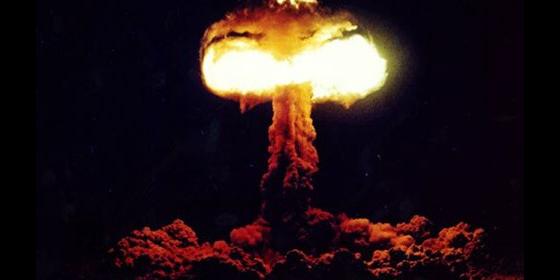
The arguments Bethe's and others had against a runaway explosion appear most authoritatively in a technical history of the bomb design program prepared under Oppenheimer's supervision immediately after the war: It is assumed that only the most energetic of several possible (thermonuclear) reactions would occur and that the reaction cross sections were at their maximum values theoretically possible. Calculation led to the result that no matter how high the temperature, energy loss would exceed energy production by a reasonable factor. At an assumed temperature of three million electron volts (compare with 35,000 eV known for D+D) the reaction failed to be self-propagating by a factor of 60. This temperature exceeded the calculated initial temperature of the deuterium reaction by a factor of 100, and that of the fission bomb by a large factor. The impossibility of igniting the atmosphere was thus assured by science and common sense. To detonate 5-10 kg of heavy hydrogen liquid would require 30 kg U235. If you use 2 or 3 tons of liquid deuterium and 30 kg U235 this would be equivalent to 100,000,000 tons of TNT. Estimated devastation area of 1000 square kilometers (360 square miles). Radioactivity lethal over the same area for a few days. The hydrogen bomb was thus under development in the US onward from July 1942. On September 17, 1942, Albany born Leslie Richard Groves, age 46, deputy chief of construction for the entire US Army, was given the command of the S-1 project, whose funding was only a week's worth of the amount of money Groves spent in his current job. He was promoted to Brigadier General. Groves was described as "a tremendous lone wolf". One of the first issues the heavyweight colonel had raised with Nichols was ore supply; was there sufficient uranium on hand? Nichols told him about a recent and fortuitous discovery: some 1,250 tons of extraordinarily rich pitchblende - it was 65 percent uranium oxide - that the Union Miniere had shipped to the United States in 1940 from its Shinkolowe mine in the Belgian Congo to remove it from German reach. Frederic Joliot and Henry Tizard had independently warned the Belgians of the German danger in 1939. The ore was stored in the open in two thousand steel drums at Port Richmond on Staten Island. The Belgians had been trying to alert the US government to its presence. On Friday, September 18, 1942, Groves sent Nichols to New York to buy it. On Saturday, Groves approved a directive for the acquisition of 52,000 acres of land along the Clinch River in Eastern Tennesee. Site X, the Met Lab called it. In October, to Compton's great relief, the brigadier had convinced E.I. du Pont de Nemours, the Delware chemical and explosives manuafacturers, to take over building and running the plutonium production piles under subcontract to Stone and Webster. Meanwhile, in December, 1942, the Chicago pile contained 771,000 pounds of graphite, 80,590 pounds of uranium oxide and 12,500 pounds of uranium metal and cost $1 million to build. It's only moving parts were its various control rods. On December 2, 1942, when the temperature was below zero, the first sustained nuclear reaction was sustained at 3:53 p.m. The Chicago pile became known as CP-1. Oppenheimer first met General Leslie R. Groves when Groves came to Berkeley from Chicago on his initial inspection tour early in October, 1942. Oppenheimer had discussed the need for a fast-neutron laboratory. "We needed a central laboratory devoted wholly to the purpose where people could talk freely with each other, where theoretical ideas and experiment findings could affect each other, where the waste and frustration and error of the many compartmentalized experimental studies could be eliminated, where we could begin to come to grips with chemical, metallurgical, engineering, and ordnance problems that had so far received no consideration. The site chosen was a boys school called Los Alamos in New Mexico and cost the government $440,000. The facility would be completely fenced in and would only have one telephone. It was designated Site Y. Robert Oppenheimer moved to Santa Fe on March 15, 1943. Oppenheimer was already calling the bomb "the gadget", a bravado metonymy that he termed. Robert Serger stated that one kilogram of U235 was equivalent to 20,000 tons of TNT. The calculations Serber reported indicated a critical mass for metallic U235 tamped down with a thick shell of ordinary uranium of 15 kilograms: 33 pounds. For plutonium similarly tamped, the critical mass might be 5 kilograms: 11 pounds. The heart of their atomic bomb would then be a cantelope of U235 or an orange of Pu239 surrounded by a watermelon of ordinary uranium tamper, the combined diameter of the two nested spheres about 18 inches. As a sideline because they agreed that work on the Super should continue at second priority, they wanted to construct and operate a plant for liquifying deuterium at -429 degrees F, the cryogenics plant was to be built near the south rim of the mesa. Seth Neddermeyer proposed packing a spherical layer of high explosives around a spherical assemply of tamper and a hollow but thick-walled spherical core. Detonated at many points simultaneously, the HE(???) would blow inward. The shock wave from that explosion would squeeze the tamper from all sides which in turn would squeeze the core. Squeezing the core would change its geometry from hollow shell to solid ball. What had been subcritical because of its geometry would be squeezed critical far faster and more efficiently than any mere gun could fire. The gun will compress in one dimension. Two dimensions would be better and three dimensions would be better still. Los Alamos was Oppenheimer's high and dry secret mesa where no one had a street address, where mail was censored, where drivers licenses went nameless, where children would be born and families live and a few people die behind a post office box in devotion to the cause of harnessing an obscure force of nature to build a bomb that might end a brutal war. On July 27th, 1943, The Hamburg firestorm was started but it peaked on July 28th. The firestorm temperature peaked at 1400 degrees F. Eight square miles of the city were completely burned. On November 29, 1943, modification of the first B-29 officially began. On February 2, 1943, the Germans surrendered at Stalingrad. The entire Oak Ridge, Tennessee facility, called the Dogpatch, was fenced off with barb wire and public access was closed on April 1, 1943. It had 55 miles of railroad bed and 300 miles of roadbed and became home for up to 13,000 workers. Electromagnetic isotope separation enlarged and elaborated Francis Aston's 1918 Cavendish invention, the mass spectograph. The method depends on the fact that an electrically charged atom travelling through a magnetic field moves in a circle whose radius is determined by its mass. The calutrons required 395 million troy ounces of silver (13,450 short tons) for their magnets. This silver cost $300 million. The Y-12 complex which did the electromagnetic isotope separation grew to 268 permanent buildings but only produced a few micrograms of U235 per day By August, 1943, 20,000 construction workers swarmed over the area. At the end of 1943, Y-12 was dead in the water with less than a gram of U235 to show for it. Gaseous diffusion was completely novel. It was based on the theory that if uranium gas was pumped against a porous barrier, the lighter molecules of the gas containing U235 would pass through more rapidly than the heavier U238 molecules. The heart of the process was therefore the barrier, a porous thin metal sheet or membrane with millions of submicrocospic openings per square inch. These sheets were formed into tubes which were enclosed in an airtight vessel, the diffuser. As the gas, uranium hexafluoride was pumped through a long series, or cascade of these tubes, it tended to separate the enriched gas moving up the cascade while the depleted moved down. However, there is so little difference in mass between the hexafluoride of U238 and U235 that it was impossible to gain much separation in a single diffusion step. That was why there had to be several thousand successive stages. Groves committed $100 million to a gaseous diffusion plant even though no practical barrier was yet in hand. A side product used in the gaseous diffusion plant would become known as Teflon in later years. The plant would hold thousands of of diffusion tanks, the largest of them of 1,000 gallon capacity, would be necessarily monumental: four stories high, almost a half mile long in the shape of a U, a fifth of a mile wide, 42.6 acres under roof, some 2 million square feet, more than twice the total ground area of Y-12's Alpha and Beta buildings. the gaseous-diffusion complex was designated K-25 and the coal fired power plant to run it was ready to go on May 31, 1943. Twelve days after Enrico Fermi proved the chain reaction in Chicago on December 2, 1942, Groves had assembled a list of criteria for a plutonium production plant and had ruled out Tennessee. The Hanford, WA site (twenty miles east of Yakima) was acquired at the end of January of 1942 at a cost of $5.1 million and consisted of 500,000 acres or 780 square miles. Dupont engineers were beginning to call plutonium production piles reactors and took note that reactors should be cooled. By August, 1943 work had begun on the water treatment plants for the three piles, capacity sufficient to supply a city of one million people. Work gangs begin to lay the 390 tons of structural steel, 17,400 cubic yards of concrete, 50,000 concrete blocks, and 71,000 concrete bricks that went into the pile buildings. The B pile would begin in February, 1944. Work on a Soviet bomb was underway in 1939. Soviet physicists realized that the United States was pursuing a bomb program when the names of prominent physicists, chemists, metallurgists and mathemeticians disappeared from international journals: secrecy itself gave the secret away. The German invasion of the USSR in June 1941 temporarily ended what had hardly just begun. In early 194, Szilard was fighting the compartmentalization philosophy of the army as implemented by Groves. Szilard wanted freedom of scientific speech. "If peace is organized before it has penetrated the public's mind that the potentialities of atomic bombs are a reality, it will be impossible to have peace that is based on reality. making some allowances for further development of the atomic bomb in the next few years, this weapon will be so powerful that there can be no peace if it is simultaneously in the possession of any two powers unless these two powers are bound by an indissoulable politic union. It will hardly be possible to get political action long that line unless high efficiency atomic bombs have actually been used in this war and the fact of their destructive power has deeply penetrated the mind of the public." The possibility of using radioactive material bred in a nuclear reactor as a weapon of war had been mentioned by Arthur Compton's National Academy of Sciences committee in 1941. German development of such a weapon began worrying the scientists at the MET lab late in 1942, on the assumption that Germany might be a year or more ahead of the United States in pile development. If CP-1 went critical in December, 1942, they argued, the Germans might have had time to run a pile long enough to create fiercely radioactive isotopes that could be mixed with dust or liquid to make radioactive (but not fissionable) bombs. Germany might then logically attempt preemptively to attack the MET lab, if not American cities. At this point, a program was started up that culminated with the destruction of the Norwegian Vemork heavy water processing plant and the last batch of heavy water being transported to Germany. Bohr had stated that if the atomic bomb worked, this development was going to bring an enormous change in the situation of the world, in the whole situation of war and the tolerability of war. The weapon devised as an instrument of major war would end major war. It was hardly a weapon at all, the memorandum Bohr was writing in sweltering Washington emphasized; it was "a far deeper interference with the natural course of events than anything ever before attempted" and it would "completely change all future conditions of warfare." When nuclear weapons spread to other countries, no one would be able any longer to win. A spasm of mutual destruction would be possible. But not war. The air-cooled pilot-scale reactor named X-10 at Oak Ridge had gone critical at 0500 on November 4, 1943. By the summer of 1944, batches of plutonium nitrate containing gram quantities of plutonium had begun arriving at Los Alamos and was quickly used in over two thousand experiments. The capture of Saipan, the largest of the Mariannas Islands had been bloody: 13,000 US casualties, 3,000 marines killed, 30,000 Japanese defenders dead. But a more grotesque slaughter had engulfed the island's population of civilians. Believing as propaganda had prepared them that the Americans would visit upon them, rape, torture, castration and murder, 22,000 Japanese civilians had made their way to the two sea cliffs, 80 and 1,000 feet high above jagged rocks and despite appeals from Japanese speaking American interpreters and even fellow islanders, had flung themselves, whole families at a time to their deaths. The surf ran ran with blood; so many broken bodies floated in the water that Navy craft overrode them to rescue. Not all the dead had volunteered their sacrifice: many had been rallied, pushed or shot by Japanese soldiers. The mass suicide on Saipan, a Jonestown of its day, instructed Americans further in the nature of the Jap. Not only soldiers but also civilians, ordinary men, women and children chose death before surrender. On the home islands, the Japanese were 100 million strong, and they would take a lot of killing. World War II would consume only 3 million tons of explosives. The largest hydrogen bomb exploded (by the Soviets) was 60 megatons, or 60 million tons of TNT. Married or single, the occupants of Post Office Box 1663 were young and healthy; they produced so many babies that Groves ordered either the reservation commander or the laboratory director to staunch the flood. Oppenheimer had a second child, a daughter Katherine, on December 7, 1944. Planning for a full scale test of an implosion weapon begin in March, 1944. The first man-made nuclear explosion would be a historic event and its designation should have a name that history might remember, Trinity. On March 3, 1944, the first dummy atomic bomb was dropped at Muroc AFB from a specially modified B-29 bomber. Paul Tibbets was 29 years old and was already regarded as the best bomber pilot at the time. His mother's name was Enola Gay Haggard, of Glidden, Iowa. The B-29 bomber was the first pressurized bomber and could fly over 30,000 feet. On November 24, 1944, one hundred planes from Saipan, were to bomb the Musashi aircraft engine factory north of Tokyo. On this mission, the bomber pilots took note that their ground speed was 450 miles per hours which was impossible at the time and concluded that they had been caught in strongs winds blowing at 145 miles per hour. The US Air Force had discovered the jet stream. Washington had secretly considered sanitizing the island of Iwo Jima using shells loaded with poison gas lobbed by ships standing well off shore. "We shall grasp bombs, charge the enemy tanks and destroy them. With each salvo we will without fail, kill the enemy. Each man will make it his duty to kill ten of the enemy before dying. Slow, cruel fighting continued for most of the month. In the end, late in March, when shell and fie had changed the very landscape, victory had cost 6,821 marines killed, 21,865 wounded of some 60,000 committed, a casualy ratio of 2 to 1, the highest in Marine Corps history. Of the Japanese defenders, 20,000 had died on Iwo jima, only 1,083 allowed themselves to be captured. On March 9, 1945, 334 B-29's took off for Tokyo loaded with more than 2000 tons of incendiaries. The Sumida River stopped the conflagration from sweeping more than 15.8 square miles of the city. The Strategic Bombing Survey estimates that probably more persons lost their lives by fire in Tokyo in a 6 hour period than at any [equivalent period of] time in the history of man. The firestorm at Dresden may have killed more people but not in so short a space of time. More than 100,000 men, women and children died in Tokyo on the night of March 9-10, 1945; a million were injured, at least 41,000 seriously; a million in all lost their homes; Two thousands tons of incendiaries delivered that punishment - in the modern notation, two kilotons. But the wind, not the weight of the bombs alone, created the conflagration and therefore the efficiency of the slaughter was in some sense still in part an act of God. As of January 1945 on any given day, about 85 percent of some 864 Alpha calutron tanks operated to produce 258 grams, 9 ounces of 10 percent enriched product. Beta tanks converted the accumulated Alpha product to 204 grams, 7.2 ounces per day of 80 percent enriched U235, sufficient enrichment to make a bomb Bertrand Goldschmidt, the French chemist who worked with Glenn Seaborg, puts the Manhattan Engineering District at the height of its wartime development with a startling comparison. It was, he writes in a memoir, "the astonishing American creation in three years at a cost of two billion dollars, of a formidable array of factories and laboratories - as large as the entire automobile indistry of the United States at that date." On April 12, 1945 at 1535, Franklin Delano Roosevelt died of a cerebral hemmorage. Hiroshima was the largest untouched target not on the 21st Bomber Command priority list. The Fat Man bomb could survive jettisoning in shallow water. Little Boy was less forgiving because it was a gun bomb with two parts to it's critical mass where sea water might intervene. Kenneth T. Bainbridge was assigned the task of finding a location for the first test. The location chosen was sixty miles northwest of Alamogordo, New Mexico. It was hoped that the Trinity test would be on July 4th, 1945. On June 27, plans were made to send Little Boy (U235) to the Pacific by ship. Two DC-3s flew out of Kirkland AFB to San Francisco to Hunter's Point Naval Shipyard to await the sailing of the U.S.S. Indianapolis, the heavy cruiser that would deliver the bomb to Tinian. A wager was made on the explosive yield. Edward Teller chose 45,000 tons, TNT equivalent, Hans Bethe chose 8,000 and Oppenheimer chose a modest 300 tons. Groves had become irritated with Fermi. "I had become a bit annoyed with Fermi... when he suddenly offered to take wagers from his fellow scientists on whether or not the bomb would ignite the atmosphere, and if so, whether it would merely destroy New Mexico or destroy the world." A young Harvard physicist, Donald Hornig was the last man to leave the top of the the tower and returned to S-10000. A series of thunderstorms rolled thru the test area and delayed the detonation time. Groves threatened to hang the meteorologists if they would not sign their forecasts. Groves then called the governor of New Mexico to warn him that he might have to declare martial law. This was probably a very awkward conversation because of the secrecy involved. A B-29 bomber was hovering at 30,000 feet several miles away from ground zero. Most of the scientists were rubbing suntan lotion on themselves at their observation point, Compania Hill, 20 miles away in the darkness before dawn. At S-10000, welders glasses (Lincoln Super-visibility Lens, Shade #10) were being used. Time: 05:29:45: The firing circuit closed: the X-unit discharged; the detonators at thirty two detonation points simultaneously fired; they ignited the outer lens shell of Composition B; the detonation waves separately bulged, encountered inclusion of Baratol, slowed, curved, turned inside out, merged to a common inward driving sphere; the spherical detonation wave crossed into the second shell of solid fast Composition B and accelerated; hit the wall of dense uranium tamper and became a shock wave and squeezed, liquefying, moving through; hit the nickel plating of the plutonium core and squeezed, the small sphere, shrinking, collapsing into itself, becoming an eyeball; the shock wave reaching the tiny initiator at the center and swirling through its designed irregularities to mix its beryllium and polonium; polonium alphas kicking neutrons free from scant atoms of beryllium, one, two, seven, nine, hardly more neutrons drilling into the surrounding plutonium to start the chain reaction. Then fission multiplying its prodigious energy release through eighty generations in millionths of a second, tens of millions of degrees, millions of pounds of pressure. Before the radiation leaked away, conditions within the eyeball briefly resembled the state of the universe moments before its primordial explosion. Then expansion, radiation leaking away. The radiant energy loosed by the chain reaction is hot enough to take the form of soft X-rays; these leave the physical bomb and it's physical casing, at the speed of light, far in front of any mere explosion. Cool air is opaque to X rays and absorbs them, heating: "the very hot air," Hans Bethe writes, "is therefore surrounded by a cooler envelope, and only this envelope" - hot enough at that - "is visible to observers at a distance." The central sphere of air, heated by the X rays it absorbs, reemits lower energy X rays which are absorbed in turn at its boundaries and reemitted beyond. By this process of downhill leapfrogging, which is known as radiation transport, the hot sphere begins to cool itself. When it has cooled to half a million degrees, in about one ten-thousandth of a second - a shock wave forms that moves out faster than radiation transport can keep up. The shock therefore separates the very hot, nearly isothermal [i.e. uniformly heated] sphere at the center," Bethe explains. Simple hydrodynamics describes the shock front: like a wave in water, like a sonic boom in air. It moves on, leaving behind the isothermal sphere confined within its shell of opacity, isolated from the outside world, growing only slowly by radiation transport on this millisecond scale of events. What the world sees is the shock front and it cools into visibility, the first flash, millseconds long, of a nuclear weapon's double flash of light, the flashes too closely spaced to distinguish with the eye. Further cooling renders the front transparent; the world if it still has eyes to see looks through the shock wave into the hotter interior of the fireball and "because higher temperatures are now revealed," Bethe continues, "the total radiation increases toward a second maximum": the second longer flash. The isothermal sphere at the center of the expanding fireball continues opaque and invisible, but it continues to give up its energy to the air beyond its boundaries by radiation transport. That is, as the shock wave cools, the air behind it heats. A cooling wave moves in reverse of the shock wave, eating into the isothermal sphere. Instead of one simple thing, a fireball is thus several things at once: an isothermal sphere invisible to the world; a cooling wave moving inward toward that sphere, eating away its radiation; a shock front propogating into undisturbed air, air that has not heard the news. Between each of these parts lay further intervening regions of buffering air. Eventually the cooling wave eats the isothermal sphere completely away and the entire fireball becomes transparent to its own radiation. Now it cools more slowly. Below the 9000 degrees F it can cool no more. Then, concludes Bethe, "any further cooling can only be achieved by the rise of the fireball due to its bouyancy, and the turbulent mixing associated with this rise. This is a slow process, taking tens of seconds. Contact with the ground was made in .65 milliseconds. At about 32 milliseconds, when the fireball had expanded to 945 feet in diameter, there appeared immediately behind the shock wave a dark front of absorbing matter, which travelled slowly out until it became invisible at 0.85 s [the expanding front about 2,500 feet across]. The shock wave became invisible at about 0.10 s. At 0836 that morning, four hours after the light flung from the Jornada del Muerto blanched the face of the moon, the Indianapolis sailed with its cargo under the Golden Gate and out to sea. Tinian is a miracle. Here, 6,000 miles from San Francisco, the United States armed forces have built the largest airport in the world. A great coral ridge was half leveled to fill a rough plain, and to build six runways, each an excellent 10 lane highway, each almost two miles long. Besides these runways stood in long rows, the great silvery airplanes. They were not there by the dozens but by the hundreds. From the air this island, smaller than Manhattan, looked like a giant aircraft carrier, its deck loaded with bombers. Stimson remarked to Harvey Bundy, with relief, "I have been responsible for spending two billion dollars on this atomic venture. Now that it is successful I shall not be sent to prison in Fort Leavenworth." On August 6, 1945, at 0227, Paul Tibbets started up the Enola Gay's engines. At 0751, at 31,000 feet, they achieved landfall at 328 miles per hour. A few minutes later the four ton payload was dropped. At 08:16:02, 43 seconds after it left the Enola Gay, 1,900 feet above the courtyard of the Shima Hospital, Little Boy detonated with an estinated force of 18 kilotons. The world of the dead is a different place than the world of the living. In Hiroshima, the two worlds converged.
August 6th 1945 - The 393d Bombardment Squadron B-29 Enola Gay, piloted by Colonel Paul W. Tibbets, took off from North Field airbase on Tinian for the primary target, Hiroshima, and with Kokura and Nagasaki as mission alternatives. The Enola Gay was accompanied by two other B-29s. The Great Artiste, commanded by Major Charles W. Sweeney, carried instrumentation, and a then-nameless aircraft later called Necessary Evil commanded by Captain George Marquardt, served as the photography aircraft After leaving Tinian the aircraft made their way separately to Iwo Jima where they rendezvoused at 8,010 ft and set course for Japan. The aircraft arrived over the target in clear visibility at 32,333 ft. Parsons, who was in command of the mission, armed the bomb during the flight to minimize the risks during takeoff. His assistant, Second Lieutenant Morris Jeppson, removed the safety devices 30 minutes before reaching the target area. About an hour before the bombing, Japanese early warning radar detected the approach of some American aircraft headed for the southern part of Japan. An alert was given and radio broadcasting stopped in many cities, among them Hiroshima. At nearly 08:00, the radar operator in Hiroshima determined that the number of planes coming in was very small - probably not more than three - and the air raid alert was lifted. To conserve fuel and aircraft, the Japanese had decided not to intercept small formations. The normal radio broadcast warning was given to the people that it might be advisable to go to air-raid shelters if B-29s were actually sighted. However a reconnaissance mission was assumed because at 07:31 the first B29 to fly over Hiroshima at 32,000 feet had been the weather observation aircraft Straight Flush that sent a Morse code message to the Enola Gay indicating that the weather was good over the primary target. Because it then turned out to sea, the 'all clear' was sounded in the city. At 08:09 Colonel Tibbets started his bomb run and handed control over to his bombardier. The release at 08:15 (Hiroshima time) went as planned, and "Little Boy", a gun-type fission weapon with 140 lbs of uranium-235, took 43 seconds to fall from the aircraft flying at 31,060 feet to the predetermined detonation height about 1,968 feet above the city. The Enola Gay traveled 11.5 miles before it felt the shock waves from the blast. Bob Caron, the tail gunner was the only crew member to see the fireball. Even wearing the goggles, he thought he was blinded. The plane raced away, while the shockwave from the explosion raced toward them at 1,100 feet per second. When the shockwave hit, it felt like a near-miss from flak. The mushroom cloud boiled up, 45,000 feet high, three miles above them, and it was still rising. They flew away, shocked and horrified at the sight below. The city had completely disappeared under a blanket of smoke and fire. They radioed back to headquarters that the primary target had been bombed visually with good results. The mushroom cloud over Hiroshima was visible for an hour and a half as they flew southward back to Tinian. The Tokyo control operator of the Japan Broadcasting Corporation noticed that the Hiroshima station had gone off the air. He tried to re-establish his program by using another telephone line, but it too had failed. About 20 minutes later the Tokyo railroad telegraph center realized that the main line telegraph had stopped working just north of Hiroshima. From some small railway stops within 9.9 mi of the city came unofficial and confused reports of a terrible explosion in Hiroshima. All these reports were transmitted to the headquarters of the Imperial Japanese Army General Staff. Military bases repeatedly tried to call the Army Control Station in Hiroshima. The complete silence from that city puzzled the General Staff; they knew that no large enemy raid had occurred and that no sizable store of explosives was in Hiroshima at that time. A young officer was instructed to fly immediately to Hiroshima, to land, survey the damage, and return to Tokyo with reliable information for the staff. It was felt that nothing serious had taken place and that the explosion was just a rumor. The staff officer went to the airport and took off for the southwest. After flying for about three hours, while still nearly 99 miles from Hiroshima, he and his pilot saw a great cloud of smoke from the bomb. In the bright afternoon, the remains of Hiroshima were burning. Their plane soon reached the area where Hiroshima once stood, and the Staff officer began to circle the area in disbelief of the view outside his cockpit window. Hiroshima was simply gone.
By 2200, August 8, 1945, Fat Man was loaded onto a B-29 named Bock's Car, named after it's commander Frederick Bock. Bock's Car left Timian at 0347 and Fat Man exploded 1,650 feet over Nagasaki at 1102 with an estimated force of 22 kilotons. On August 10, the Japanese send out the white flag through Switzerland. The third bomb was to be sent to Timian on August 12 and be ready for delivery by August 17th. The Japanese emperor wrote: "Despite the best that has been done by everyone... the war situation has developed not necessarily to Japan's advantage while the general trends of the world have all turned against her interest. Moreover, the enemy has begun to employ a new and most cruel bomb, the power of which to do damage is indeed incalculable, taking the toll of many innocent lives... This is the reason why We have ordered the acceptance of the provisions of the Joint declaration of the Powers.... The hardships and suffererings to which Our nation is to be subjected hereafter will be certainly great. We are keenly aware of the inmost feelings of all ye Our subjects. However it is according to the dictate of time and fate that We have resolved to pave the way for a grand peace for all generations to come by enduring the unendurable and suffering what is unsufferable... Let the entire nation continue as one family from generation to generation...." The experience of Hiroshima and Nagasaki was the opening chapter to the possible annihilation of mankind. The US government published a detailed report on the scientific aspects of the atomic bomb development with Groves approvement. H. G. Wells lived to know of Hiroshima and Nagasaki. Deeply pessimistic in his final years, he died at eighty on August 13, 1946.
The Super conference examined only one design for a thermonuclear weapon, the design Teller and his group had developed during the war, the so-called classical Super, with an estimated explosive force of 10 megatons. The ingredients for the classical Super would be an atomic bomb, a cubic meter of liquid deuterium and an indefinite amount of the rare isotope of hydrogen, tritium, which because of it's short 12.26-year half life does not normally exist in nature but can be created in a nuclear reactor by bombarding lithium with neutrons. How those components would have been arranged in the classical Super is still secret: probably spherically, the fission trigger and hydrogen isotopes physically contiguous and contained a heavy tamper. In June 1946, three months after the Super conference, the US nuclear weapons stockpile consisted of nine Fat Man bombs, of which no more than seven could be made operational for lack of initiators. The stockpile held only thirteen bombs a year later, two years after the end of the war. Plutonium production was the crucial bottleneck. The high neutron flux of he Hanford production piles had proven damaging. On September 23, 1949, the Soviets exploded their first atomic bomb. Stanislaw Ulam realized that if the thermonuclear materials were physically seperated from the fission primary, the enormous flux of X rays coming off the primary might be applied somehow to start the thermonuclear burning in the fraction of a second before the slower shock wave caught up and blew everything apart. The X rays from the primary might heat the thermonuclear secondary directly (as microwaves heat food in a microwave oven) but they could not squeeze it efficiently to the greater density that would promote fusion. Some other material would need to intervene. It turned out that ordinary plastic would serve. Dump so large a flux of X rays into a layer of plastic foam wrapped around a cylindrical stick of thermonuclear materials and the plastic would heat instantaneously to a plasma - a hot ionized gas - expanding explosively at pressures thousands of times more intense than the pressures high explosives can generate. So a fission primary - a little Fat Man, no larger in today's efficient weapons than a soccer ball - might occupy one end of an evacuated cylindrical casing. Farther along the casing, a layer of plastic might wrap a cylindrical arrangement of thermonuclear material. Fire the primary and the X ray flux would radiate the plastic at the speed of light faster than the expanding fission shock wave coming up from behind. Configuring the plastic would be much simpler than configuring the high explosive lenses; the light-swift X rays would irradiate it simultaneously along its entire length and the resulting implosion would be beautifully symmetrical. The second half of the new concept was probably a further nesting of cylinders within cylinders: an outer casing of U238 to scatter X rays from the primary into the plastic; a layer next of plastic; a layer next of U238 tamper; a layer next of thermonuclear materials; and at the axis of the cylinder a stick of plutonium. It would also start a second fission chain reaction in the stick of plutonium by squeezing it to critical mass. That would add a further flux of heat and pressure to the thermonuclear materials and push the fusion reaction over the top. The U238 later, in turn would benefit from the dense flux of neutrons released in thermonuclear burning and would fission above the 1 MeV U238 fission threshhold. Neutrons from that fission would then contribute to preparing the thermonuclear materials for further burning. Such a design is usually described as fission-fusion-fission. On November 1, 1952, the Mike shot on the small island of Elugelab weighted 65 tons and yielded 10.4 megatons. The fireball expanded to 3 miles and the explosion generated a crater half a mile deep and two miles wide. Mike was fueled with liquid deuterium and tritium for simplicity of measuring. For a deliverable bomb, the thermonuclear material of choice would be lithium deuterium, a stable powder, the lithium in the form of the isotope Li6, which constitutes 7.4 percent of natural lithium but can be separated from it relatively easily. Neutrons from the fission components of a lithium fueled bomb would produce tritium almost instantly from Li6 which would then fuse with the deuteride to develop the thermonuclear burning just as the wet and bulky liquid hydrogen isotopes had done in Mike. The dry design was tested in the spring of 1954 in Operation Castle. The Castle Bravo test was a device using LiD as its fuel and yielding 15 megatons. It was the first hydrogen bomb small enough to be delivered by plane. A true Soviet thermonuclear, dropped from an aircraft in test, followed on November 23, 1955. ---------------------------------------------------------------------------- Simon and Peierls settled on ordinary gaseous diffusion (as opposed to gaseous thermal diffusion as the best method for isotope separation. Gases diffuse through porous materials at rates that are determined by their molecular weight, lighter gases diffusing faster than heavy gases. In the case of uranium hexafluoride, the enrichment factor would be slight, 1.0043 under ideal circumstances. But with enough repetitions of the process, any degree of enrichment was possible. The Battle of Britain began in mid-August in 1940. By November, 13,700 tons of high explosives had fallen and 12,600 tons of incendiary cannisters, an average of 201 tons per night; for the entire Blitz, September to May, the total tonnage reached 18,800 - 18.8 kilotons, spread across nine months. London civilian deaths in 1940 and 1941 totaled 20,083. Only 42 civilians lost their lives in 1942. The first separation of U-235 and U-238 was accomplished on February 28 and 29, 1940 and the sample was sent to Columbia University. Oak Ridge Alpha I calutron racetrack for the electromagnetic separation of U235. The K-25 gaseous diffusion plant in Oak Ridge, Tennessee was half a mile long and covered 42.6 acres under roof. The plutonium production complex off the Columbia River at Hanford, Washington.
Oak Ridge Uranium Processing Plant http://maps.google.com/maps?f=q&hl=en&geocode=&q=Oak+Ridge,+TN&ie=UTF8&ll=35.934131,-84.39311&spn=0.016401,0.021372&t=h&z=16&om=1 Hanford, WA Nuclear Reservation http://maps.google.com/maps?f=q&hl=en&geocode=&q=Hanford,+WA&ie=UTF8&ll=46.556618,-119.532795&spn=0.055715,0.085487&t=h&z=14&om=1 Los Alamos, NM http://maps.google.com/maps?f=q&hl=en&geocode=&q=Los+Alamos,+NM&ie=UTF8&ll=35.870777,-106.320877&spn=0.016414,0.021372&t=h&z=16&om=1 Alamogordo, NM http://maps.google.com/maps?f=q&hl=en&geocode=&q=Alamogordo,+NM&ie=UTF8&ll=33.014421,-106.211014&spn=0.543531,0.683899&t=h&z=11&om=1 http://www.radiochemistry.org/history/nuke_tests/trinity/index.html Ivan The Terrible http://en.wikipedia.org/wiki/Tsar_Bomba Castle Bravo http://en.wikipedia.org/wiki/Castle_Bravo Atomic craters near Las Vegas http://maps.google.com/?ie=UTF8&t=h&om=0&ll=37.158264,-116.05854&spn=0.047404,0.089951&z=14 obergruppenfuhrer, Schultzstaffel (SS) In the 1960s and 1970s, theoretical physicists developed a standard model of high energy physics, which predicted what kind of particles come together to form electrons, protons and neutrons. Since then, 12 major subatomic particles have been discovered: six uncharged particles called leptons and six charged particles called quarks. Physicists have also identified five particles that carry force, known as bosons. The evasive Higgs boson is the only one that has yet to be observed. |
||||||||||
|
There are three stages to the detonation of a hydrogen weapon: fission,
fusion, and more fission. These happen so rapidly, we see only one event.
The primary system (the minature A-bomb) is called the trigger. (not sure size of the kiloton range of the trigger, but probably low) Fusion causes hydrogen to fuse into helium. The challenge in designing a hydrogen weapon is to make the secondary system finish its task of fusion before the expanding fireball of the primary system engulfs and destroys it. About one millionth of a second is all the time available for doing the job.. X and gamma radiation travel at the speed of light, more than a hundred times faster than the expanding debris from the exploding A-bomb. If the primary system and the fusion fuel are located some distance apart, say twelve inches, the radiant energy of the primary system will have time to race ahead of the expanding nuclear debris and reach the fusion fuel first. The cylindrical shape of most hydrogen weapons plays an important role in determining how this radiant energy will be distributed inside the casing. The primary system is located inside one end of the three or four foot long hollow cylinder casing, and the fusion fuel is located inside the other end. The cylinder is normally eighteen inches in diameter, large enough to contain the soccer ball sized primary system inside one end and leave a few inches to space around the sides. A complete one-megaton bomb (having the explosive power of one million tons of TNT) would fit neatly under your bed. The cylindrical casing is more than just the package that holds the nuclear parts together. It is also a radiation reflector designed to capture radiation from the primary system and focus it on the fusion fuel. It is the largest and heaviest component of any hydrogen weapon and one of the most important. The reflector casing is usually made of Uranium-238, a heavy shiny metal called depleted uranium. In the last stage of the weapon's detonation sequence, the depleted uranium explodes with the power of many Hiroshima bombs, producing most of the weapon's deadly fallout. However, the first function of the Uranium-238 in the secondary system is to serve not as an energy source but as a finely engineered energy reflector. All these components are made at the Y-12 Union Carbide facility in Oak Ridge, Tennessee. The raw material for the Uranium-238 come from Fernald, Ohio where gaseous Uranium-238 has been chemically reduced to pure metal blocks. Fusion is called a thermonuclear process because heat makes it happen. Temperatures of several million degrees Celsius are needed to start the process. However the rate of fusion is determined by the density of the hydrogen fuel. In a weapon, the rate of fusion must be extremely rapid. For a useful amount of fusion fuel to fuse in the alloted millionth of a second, it must first be greatly compressed. Without tremendous compression, the fusion fuel would not fuse fast enough to add much energy to the explosion before it was scattered uselessly by the expanding fireball of the primary system. In a hydrogen weapon, radiation pressure is what compresses the fusion fuel sufficiently to make the device destroy a city's suburb as well as it's center. Radiation pressure, the principle by which the secondary system works, is normally too weak to be detected by human senses, You cannot feel the physical push of a flashlight beam, for instance. There are no examples in the human environment of radiation intense enough to move solid objects with more than a barely measurable force. But the primary system of a hydrogen weapon is a nuclear power plant that generates twenty million kilowatt hours worth of thermal energy in a few billionths of a second, all inside a lump of metal compressed to the size of a baseball. Its radiant energy can exert enormous force on an object located a few inches away. In fact, the radiation pressure inside the weapon casing can theoretically be as high as a million, million times greater than atmospheric pressure - about eight billion tons per square inch. Physicists would describe the radiation as a "gas of photons", a dense cloud of highly energetic pulses of electromagnetic energy pushing violently against anything it touches. For the briefest moment, the inside of the weapon becomes an X-ray oven, similar in principle to a microwave oven, but with uneartly temperatures and pressures. As any science student can tell you, heat is the enemy of compression. The greatest densities are achieved when a substance is compressed cold. Heat tends to make it expand. Because fusion fuel in a weapon must therefore be compressed before it reaches ignition temperature, the fusion fuel of the secondary system is not exposed directly to radiation from the primary system. It is protected on the end nearest the primary system by a large radiation shield. Around the sides of the fusion fuel is a tapered cylinder called the fusion tamper. Radiation from the exploding fission trigger is reflected around the large shield or pusher, in the center of the weapon and onto the sides of the fusion tamper. The fusion tamper then collapses inward with enormous force, driven by the pressure of the X and gamma radiation from the primary system. The fusion tamper compresses the fusion fuel and simultaneously heats its perimeter to ignition temperatures. An important part of nuclear weapon design is the judicious use of empty spaces inside the weapon. The empty space between a raised hammer and a nail allows the hammer to strike the nail with much greater force than could be mustered if the hammer were placed on the nailhead before pressure was applied. In a hydrogen weapon, the fusion tamper serves as a hammer that strikes the fusion fuel simultaneously from all sides, compressing the fuel, the empty space between the fusion tamper and the fuel is used to produce the maximum compression. In addition, the delicate ceramic like fusion fuel must be firmly cradled and supported from all sides during the weapon's possible rough ride to the target. A key ingredient in the design of this aspect of the secondary system is the polystyrene foam that keeps the fusion fuel centered inside the fusion tamper. By holding the fuel and tamper apart, the foam allows the tamper to develop momentum before it strikes the fusion fuel. Polystyrene foam is thus both a packaging material and an empty space, protecting the hydrogen fuel during weapon delivery and collapsing into nothing during detonation. The foam is made in Kansas City, Missouri by the Bendix Corporation in a factory that manufactures most of the non-nuclear parts for nuclear warheads and bombs. Only the heavier isotopes of hydrogen serve as a fuel in a hydrogen weapon. Hydrogen-2 and Hydrogen-3 known respectively as deuterium and tritium, are the fuel which explodes with the force of many trainloads of TNT. Tritium is expensive and highly radioactive. For practical purposes, most of the tritium is stored in the weapon as lithium-6, a less expensive, non-radioactive material which is converted instantly to tritium once the fusion process begins. Conveniently, lithium-6 bonds chemically with deuterium to make a gray powder, called lithium-6 deuteride, that is much easier to manage than either pure deuterium or tritium in gaseous form, although it must be kept dry. The fusion fuel in a hydrogen weapon, except for a small amount containing tritium, is made at the Oak Ridge Y-12 plant. Metallic lithium-6 is chemically bonded with deuterium obtained from the Department of Energy's Savannah River plant (operated by Dupont) and compacted into a chalk like substance, resembling a large aspirin tablet in consistency. The pressed powder is then baked and machined to its final dimensions. The result is a ceramic material so unstable chemically in the presence of moisture that it must be assembled in "dry rooms". Dry room workers in the Y-12 plant wear air-conditioned waterproof body suits with sealed fish-bowl helmets to keep their body moisture from causing the lithium-6 deuteride to decompose spontaneously. When viewed through the windows of their dry rooms, they look like astronauts on a training exercise. When the charge of lithium-6 deuteride for a single weapon is assembled, it makes a column one or two feet hight and several inches in diameter. It is tapered to fit inside the fusion tamper the way the core of a carrot fits inside a carrot.. When this charge of fusion fuel is struck simultaneously on all sides by the exploding fusion tamper, it is compressed and heated. Fusion begins in the perimeter where some tritium is present. The lithium-6 is converted to tritium throughout the charge, while the exploding perimeter further compresses the center and the bulk of the fusion fuel fuses and explodes. The third and final stage in the explosion of the weapon is virtually an afterthought. In fact, it is optional, although in most hydrogen weapons it is a highly desirable option - it provides roughly half the total energy release of the weapon and most of the fallout. In this third stage, the Uranium-238 casing which was used to capture and focus the radiation undergoes fission as a result of bombardment by the high-energy neutrons released by the second-stage fusion process. The result can be an explosion a thousand times more powerful than the blast that destroyed Hiroshima. Continued nuclear testing underground in Nevada is a paradox unless you know the secret. Underground nuclear explosions are never higher in yield than a few kilotons despite unofficial acknowledgement that our latest strategic nuclear weapons are in the 100 to 500 kiloton range. The widesprfead belief that the weapon makers are testing only the primary systems, or triggers, is incorrect. The primary system can be tested without an actual nuclear detonation. The fissible material, Plutonium-239 and Uranium-235 can be replaced with electronic sensing devices, and the high-explosive charges detonated. Instrument readings and high speed photographs tell the designers most of what they need to know about the primary system. Such tests are conducted frequently, above ground at the nuclear weapons laboratories in Los Alamos, New Mexico and Livermore, California. The explosion is as powerful as that of an ordinary mortar shell (but far more dangerous because it scatters a cloud of Uranium-238 and Beryllium dust. The secondary system, on the other hand cannot be tested without the intense radiation that comes only from an exploding fission weapon. The primary system must actually be detonated with a nuclear yield in order for the secondary system to be tested. The fusion fuel in the secondary system can be replaced with electronic sensing devices. The second and third stages of the explosion need not occur, but the primary system must explode in all of it's fury if useful information is to be had about the rest of the weapon. Hence, the weapon makers compulsion for underground testing. As refinements in radiation reflector design have allowed more of the energy of the primary system to be captured and focused, smaller fission explosions have become adequate as triggering events. One result of fifteen years of underground tests is a reflector that will set off half a kiloton of secondary fusion explosion with as little as half a kiloton of fission energy. Enter the neutron bomb. The neutron bomb radiation reflector has to be made of a high-density metal other than Uranium-238, so there will be no dirty fission explosion following the fusion. The metal is probably tungsten alloyed with nickel, iron and perhaps rhenium. Underground testing was part of its design procedure. Unofficial sources say that a neutron weapon with a total energy yield of one kiloton, one twentieth of the Nagasaki weapon, must contain more radioactive tritium than a full megaton weapon of more conventional design. The reason is that the deliberately weak neutron weapon is unable to generate much of it's own tritium; more of it must be provided ready-made. The country's sole supplier of tritium is also the sole supplier of Plutonium-239.
The Uranium-238 tamper that makes the carrot shaped container of fusion fuel is surrounded by an exotic high density polystyrene foam. The X and gamma rays from the primary trigger transforms the foam into a highly energized plasma which explodes and compresses the fusion fuel package. The center of the fusion fuel carrot contains a one or two inch rod of highly enriched uranium or plutonium along its entire length. That rod of fissionable material is compressed to super criticality by the exploding styrofoam and becomes a second A-bomb and ignites the fusion fuel from the inside.
High explosives in the primary system begin to burn, driving the beryllium neutron reflectors and heavy Uranium-238 tamper inward toward the fissible core. The space between the tamper and the core allows the tamper to develop momentum before hitting the core. The fissible core is squeezed to more than double its normal density, going supercritical. Neutrons are fired from a high voltage vacuum tube to start a chain reaction in the fissible material. The chain reaction concentrates first in the fast-fissioning Plutonium-239. The chain reaction spreads to the slow-fissioning Uranium-235. Fusion fuel at the center of the core showers the core with neutrons, boosting fission efficiency. As the core expands to its original size, reaction stops, completing the first stage of the detonation. Energy release so far: forty kilotons. Prompt X-rays and gamma rays travel outward at the speed of light. The weapon casing reflects radiation pressure around the thick radiation shield and onto the sides of the fusion tamper, collapsing the tamper inward. Heat and pressure of the impact start fusion in the tritiated portion of the fusion fuel pencil. The precise location of the tritium within the pencil depends on where the designer intends the fusion reaction to begin. Neutrons from the fusion activity breed tritium throughout the pencil. Fusion fuel reacts virtually simultaneously throughout the pencil, releasing 130 kilotons of energy to complete the second stage. High energy neutrons from fusion are absorbed by the Uranium-238, which so far has served as a fission tamper, radiation shield, radiation reflector and fusion tamper. Now it serves as fission fuel. Uranium-238 fissions adding another 130 kilotons of energy to the explosion and generating enough fission products to kill everyone within 150 square miles with fallout. A fireball begins to develop...
The Smyth Report http://nuclearweaponarchive.org/Smyth/ http://www.atomicarchive.com/Docs/SmythReport/index.shtml |
||||||||||
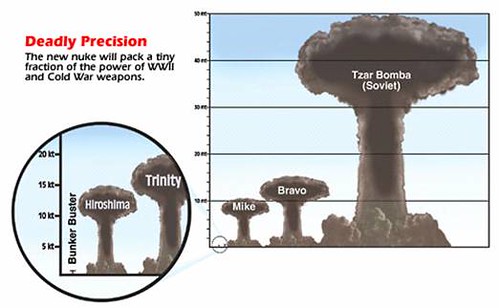
| ||||||||||
|---|---|---|---|---|---|---|---|---|---|---|
| Dark Sun: The Making of the Hydrogen Bomb | ||||||||||
|
Gore Field in Great Falls, Montana was used in the WWII Lend-Lease program
to transport materials to the Soviet Union because the Germans made the
Atlantic too risky.
Vadum enumerated the perverse physical characteristics that made "hex" hellish stuff - the heavy corrosive gas destroyed lubricant, disassociated in the presence of water vapor and attacked equipment. A gaseous-diffusion plant would be huge, the British had calculated 1,900 ten stage units occupying a plant area of some twenty acres. In November, 1942, the Red Army was able to mount a great counteroffensive. Stalingrad was the turn of the tide. U235 which constitures only 1/140th part of regular uranium, would be useful in a pile. the rest of the uranium - U238, constituting 139/140ths would be useless, since it does not emit large amounts of energy or produce secondary neutrons when hit by a slow neutron. The great offensive into Berlin was launched at 4 a.m. on April 16, 1945. We had used 22,000 guns and mortars along the Oder, and 4,000 tanks were thrown in. We also used 4,000 to 5,000 planes. During the first day alone, there were 15,000 sorties. The Soviets suffered over 300,000 casualties in the final battle and the Germans lost 150,000 men and another 300,000 surrendered. The war in Europe ended in a school room in Rheims on the morning of May 7, 1945 when Colonel General Alfried Jodl signed the act of military surrender. May 9th was an unforgettable day in Moscow. The NKVD (Soviet secret police) under Lavrenti Beria had murdered at least ten million Soviet citizens, a slaughter more extensive than that of the Holocaust. In the age groups that had borne arms, there were at the end of the war only 31 million men left, as against 52 million women. The Germans had destroyed 1,700 towns, 70,000 villages, 84,000 schools, 40,000 hospitals, 42,000 public libraries. Twenty five million were left homeless. Coal production compared to 1941 was down 33 percent, oil down 46 percent, electricity down 33 percent, pig iron down 54 percent, steel down 48 percent, coke down 46 percent, machine tool production down 35 percent. Thirty one thousand industrial enterprises had been destroyed; overall Soviet industry had been razed to one half the pre-war level. Ninety-eight thousand collective farms and 1,800 state farms were destroyed or looted. Molotov reported in 1947; 7 million horses, 17 million heads of cattle, 20 million pigs, 27 million sheep and goats had vanished. Meat production was down 40 percent, dairy production was down 55 percent. The Red Army was the strongest force in Europe but the Soviet people were exhausted and nearly starving. Now the nation would have to gear up to build the atomic bomb. In May 1941, University of Kyoto physicist Tokutaro Hagiwara in a lecture on "Super-explosive U235" had commented that the fissionable uranium isotope has a great possibility of becoming useful as the initiating matter for a quantity of hydrogen. Hagiwara was the first scientist on record to notice that an explosive fission chain reaction might generate enough energy to force hydrogen to fuse to helium, with the potential for producing a far larger nuclear explosion than fission could yield alone. Ernest Rutherford and two of his younger colleagues at Cambridge, Marcus Oliphant and Paul Hartneck had discovered the hydrogen fusion reaction in 1934. In a paper titled "Transmutation effects observed with heavy hydrogen", they described bombarding hydrogen2 - deuterium in the form of concentrated heavy water with deuterium-accelerated nuclei. A hydrogen nucleus contains a single proton, making it the lightest of all elements. Deuterium is an isotope of hydrogen with a neutron in its nucleus as well and is therefore twice as heavy. Acceleration gave the deuterium nuclei of ther 1934 experiment enough energy to overcome the positive electrical repulsion between the nuclei of probe and target. The result, to the experimenters surprise was "an enormous effect", specifically the union of two deuterium nuclei to form a new nucleus of helium. Driven into proximity by the energy of acceleration, which is essentially a form of heat, the deuterium nuclei had fused together to form the next lightest element in the periodic table, helium, with two protons and one neutron in its nucleus. Neutrons, heat and intense gamma radiation came out of the reaction as well as the new nucleus adjusted its energy level and stabilized. In 1939, Hahn and Strassman published their paper on the fission of the uranium nucleus. Because fusion reaction depended on heating the nuclei until their thermal motion overcame their electrical repulsion, the reaction came to be called "thermonuclear fusion". In the center of an exploding fission bomb, notes theoretical physicist Herbert York, temperatures substantially exceeding 100,000,000 degrees are produced, and so at least one of the conditions necessary for igniting a thermonuclear reaction under the control of man seemed to be within reach. Each gram of deuterium converted to helium should release energy equivalent to about 150 tons of TNT, 100 million times as much as a gram of ordinary chemical explosive and eight times as much as a gram of U235. Twelve kilograms of liquid deuterium ignited by one atomic bomb would explode with a force equivalent to one million tons of TNT, one megaton. A cubic meter of liquid deuterium would yield 10 megatons. Edward Teller made the realization of Fermi's idea the focus of his life. At Los Alamos in 1943, Teller signed on a Polish mathematician named Stanislaw Ulam, whom John von Neuman had recommended, to help with the work. An important difference between a fission bomb and a thermonuclear bomb was that except in its fission trigger, the thermonuclear would require no critical mass. As the fission bomb exploded, it disassembled its critical mass, at which point fissioning stops. The disassembly process set a natural limit to the size of fission explosions of about one megaton. A thermonuclear explosion however, if it could be made to ignite and sustain thermonuclear burning would proceed like a nuclear version of a chemical explosion, continuing to burn so long as it had access to thermonuclear fuel. The stars, thermonuclear furnaces thousands and millions of times as large as the Earth, made it obvious that there were no inherent limits to the size of thermonuclear explosions. Teller was still concerned about the possibility of a fusion explosion igniting the atmosphere of the earth, which is predominantly nitrogen, in a nuclear Armageddon; he thought the nitrogen plus nitrogen reaction should certainly be studied. At 6 p.m. on December 25, 1946, the first Soviet reactor was operational. On July 36, 1947, Truman signed the National Security Act. This replaced the army and navy into a Department of Defense. It also created a separate air force, the Central Intelligence Agency and the National Security Council. In mid October of 1946, the Joint Chiefs of Staff (JCS) decided that the United States could use no more than 150 Nagasaki type bombs based on 100 urban centers in the USSR. In October, 1947, the US military believed that 150 atomic bombs with a total yield of 3 megatons would be sufficient. Two years after the end of the war, thermonuclear research at Los Alamos was still almost entirely theoretical. For the Super, Teller proposed exploring the production and use of a gray salt like compound of a lithium isotope and deuterium, lithium(6) deuteride as a fuel alternative to liquid deuterium. Lithium, a soft silvery-white metal, atomic number 3, was already in use in the American bomb program in the form of lithium fluoride slugs which were irradiated in the Hanford reactors to produce tritium. In an emergency, the United States at the end of 1947 had available an arsenal of at least 56 bombs, each one sufficient to destroy a city. perspicacious: perceptive, acute, shrewd, penetrating The MVD committed no worse felonies than the rearrest, on the same charge, of people who had completed their sentences and been released as well as the non-release of prisoners after they had served their full terms. Those arrested during the bloody years of 1937 and 1938 were either shot or sentenced to ten years; longer terms, especially the ubiquitous twenty-five years, were instituted during and after the war. This meant that large numbers of political prisoners would have to be released in 1947, and the slave labor force so badly needed for the post-war industrial economy greatly depleted. An ingenious solution was to rearrest the released prisoners and, ten years later start a new wave of terror - the 1947-1953 mass arrests - to prevent the shutting down of the camps and to provide the new building projects with penal labor. Politically, too it was most expedient to keep the innocent victims of 1937 and 1938 in continued isolation, lest they besmirch the good name of the Party. It was killing two birds with one stone. At 6 a.m. on June 24, 1948, the Berlin blockade begin. It was one of the most ruthless efforts in modern times to use mass starvation for political coercion. The first direct confrontation of the Cold War between the United States and the Soviet Union had begun. The fissioning of the system's plutonium core would heat the tamper materials to thermonuclear temperatures. Under such extreme conditions, matter is almost completely ionized - bare nuclei stripped of their electrons, that is - and such ionization would equalize pressures between the layers of heavy and light elements. High energy neutrons released in fusion would then immediately fission the U238 tamper nuclei mixed with the fusing hydrogen nuclei, greatly increasing the yield in a system that might be no bigger than a Fat Man system. This mechanism became known as fission-fusion-fission. The Sandstone tests of 1948 - of levitated composite core technology in particular - had established that a much larger atomic arsenal might be forthcoming within the near future, no less than a 63 percent increase in the total number of bombs in the stockpile and a 75 percent increase in their total yield. The AEC reported to the JCS in October, 1948 that 400 atomic bombs would be available by 1951. The first atomic test in the US was called Trinity. The first Soviet test was called First Lightning on August 29, 1949 at 7 a.m. Waves of fluttering feather grass rolled away from us across the field. Minus five minutes, minus three minutes, one, thirty seconds, ten two, zero. In the command bunker, Kurchatov turned abruptly to the open door. Light flooded the steppes. It worked, Kurchatov said simply. What remarkable words, writes Zukwerman - It worked. It worked! If it had not worked, one of them told a German chronicler later, they would all have been shot. Lavrenti Beria called Stalin to report the success. Stalin had already been notified and Beria was furious.
Stalin:  What do you want?  Why are you calling me?
Beria:   Everything went right.
Stalin:  I know already.  (hangs up)

Beria went wild and attacked the general on duty.
Beria:   Who has told him?  You are letting me down.  Even here you spy
         on me.  I'll grind you to dust.
The Soviet Union's first successful test of a 22-kiloton nuclear weapon - called First Lightning - on 29 August 1949 was, in effect, the day that began the Cold War. Necessarily, such a weapon goes far beyond any military objective and enters the range of very great natural catastrophes. By its very nature, it cannot be confined to a military objective but becomes a weapon which in practical effect is almost one of genocide. It is clear that the use of such a weapon cannot be justified on any ethical ground which gives a human being a certain individuality and dignity even if he happens to be a resident of an enemy country. It is evident to us that this would be the view of peoples in other countries. Its use would put the United States in a bad moral position relative to the peoples of the world. Any post war situation resulting from such a weapon would leave unresolvable enmities for generations. A desirable peace cannot come from such an inhuman application of force. The postwar problems would dwarf the problems which confront us at present. The fact that no limits exist to the destructiveness of this weapon makes its very existence and the knowledge of its construction a danger to humanity as a whole. Question/answer session with Oppenheimer....
Q. In fact, Doctor, you testified, did you not that you assisted in
   selecting the target for the drop of the bomb on Japan?
A. Right.
Q. You knew, did you not that the dropping of that atomic bomb on the target
   you selected would kill or injure thousands of civilians, is that correct?
A. Not as many as turned out.
Q. How many were killed or injured?
A. Seventy thousand.
Q. Did you have moral scruples about that?
A. Terrible ones...
Q. Would you have supported the dropping of a thermonuclear bomb on
   Hiroshima?
A. It would make no sense at all.
Q. Why?
A. The target is too small.
At 4 a.m. on Sunday, June 25, 1950, the North Korean army attacked on the Ongjin Peninsula on the western coast of Korea. Fairfield-Suisun AFB had been renamed Travis AFB in honor of the only US general ever killed by an atomic bomb. When a mass of uranium or plutonium fissions in an atomic bomb, nearly all the energy released takes the form of electromagnetic radiation, the class of radiation that includes visible light. Such radiation consists of weightless packets of waves called photons which travel at the speed of light: 186,400 miles per second or 1 foot per nanosecond. Photons have wavelengths that differ according to their energy - the more energetic the photon the shorter the wavelength. The coils of a heater demonstrate the connection between energy and wavelegth as they warm and begin to glow, heating from invisible longer waves of infrared (which humans perceive as warmth) to dark red to orange to yellow, each color produced by the effect on the human eye of photons of progressively shorter wavelength. An even hotter acetylene torch burn blue-white. Farther up the same continuum, a hot sunlamp filament radiates invisible ultraviolet light. Beyond ultraviolet comes soft X rays and gamma rays, all a function of the temperature of the radiating material (that is, of the energetic motion of the material's atoms), each type of radiation consisting of photons of shorter wavelength than the last. A nanosecond is one billionth of second.
Teller asked what component of an exploding fission bomb could be used
to ignite deuterium/tritium outside a bomb. Neutrons pour out of an
exploding fission bomb in weighty quantities and could certainly serve that
purpose, but because they have mass they move more slowly compared to
massless protons. In fact the first component of a fission bomb to move
out from the core, well ahead of any material particles such as neutrons or
fission fragments is radiation. An X ray photon travels ten feet in the
same time it takes for a uranium nucleus to fission: in the same brief time
fission fragments move only about four inches, neutrons (because they are
lighter somewhat more). The choice of using radiation is forced on you.
George would be a tower shot; after two tests of new more efficient and
compact fission designs, the task force fired the Cylinder on May 9, 1951.
Allred and Rosen measured neutrons with energies of 14 million electron
volts (MeV), one unique signature of the reaction of
Deuterium and Tritium (D + T). Less than ounce of D+T added about
25 kilotons to the yield.
Greenhouse Item fired on May 25, 1951 proved the principle of DT gas boosting
yielding 45.5 KT from an all U235 implosion design that would otherwise have
produced no more than half that yield.
A US Minuteman III missle carries three Mark 12A devices, each 5.9 feet long
and 21 inches in diameter, each yielding 350 kilotons. The Hiroshima bomb was
a mere 18 kilotons.
The team that Marshall Holloway assembled to design and build the first
megaton-scale thermonuclear - the Panda Committee, also known as the
Theoretical Megaton Group - met for the first time on October 5, 1951, two
days after the Whitehouse announced the detection of a second Soviet
atomic bomb explosion.
The great virtue of lithium, of course, is that it provides you with a
free source of tritons (tritium nuclei). That's only true of the isotope
Lithium(6). We did not have large quantities of separated lithium isotopes.
We set out to get them and by 1954 we had them. We could have had them
earlier if we had known enough to go after them.
The thermonuclear secondary, which would essentially be a bottle of liquid
deuterium with a stick of plutonium mounted inside for a spark plug, would
hang in the center of the big steel casing below the fission primary behind
a heavy blast shield. The flux of the soft X rays were hot, however so hot
that they would ionize materials instantly and turn such materials into
a plasma hot enough to radiate further X rays.
Materials are said to ionize when they are heated sufficiently to break up
their atoms into electrons and nuclei - negative and positive ions.
Plasma is the fourth state of matter - solids, liquids and gases are three
more familiar states of matter - consisting of hot, ionized gas; the sun
is a ball of plasma maintained by nuclear burning.
So the steel casing would have to be lined with material that would absorb
the radiation and ionize it to a hot plasma which could radiate X rays
to implode the secondary.
As the radiation flowed from the primary end of the casing around and
past the secondary, it would start generating radiation pressure at the end
nearer the primary sooner than at the end farther away.
Scottish physicist James Dewar first produced liquid oxygen in quantity and
liquified hydrogen in 1898. In 1892, Dewar invented the double-walled flask
with a vacuum between the two walls that we know as a thermos bottle.
The polythylene would function as the plasma generator as well.
A fission implosion used a tamper to smooth out its high-explosive shock
wave and to hold the core assembly together by inertia a few microseconds
longer to allow a few more chain reaction generations to occur increasing
the efficiency of the explosion. The Sausage secondary also needed a tamper.
It would function not only as a tamper, to hold the secondary together,
but also as a pusher to transfer the energy from the hot ionized
polythylene plasma into the liquid deuterium. The cylindrical pusher would
be cast of thick heavy pieces of U238, the largest uranium castings made
up to that time. X rays from the fission primary would heat the plastic
that lined the outer Sausage casing. The resulting hot plasma would reradiate
longer wave-length X rays inward from all sides toward the thick uranium
pusher. The X rays would heat the surface of the pusher so hot that it would
ablate: boil vaporized uranium off its outer surface. To every action, there
is an equal and opposite reaction: the ablating vapor would function as
burning fuel ejecting from the nozzle of a rocket functions, accelerating
the pusher shell inward and rapidly compressing the liquid deuterium to
fusion-ignition temperatures. But the Sausage pusher would serve another
important function as well. It would serve as an additional source of fuel
soaking up the high-energy neutrons that the thermonuclear reaction would
generate that would otherwise escape the explosion and go to waste, neutrons
energetic enough to fission U238 and contribute significantly to the overall
yield.
The Marshall Islands where the Eniwetok Atoll is, are about 3,000 west
of Hawaii.
H-hour for the Ivy Mike shot was 7:15 a.m., November, 1952, localtime.
October 31, 1952 in the US.
A momentary power failure aboard the Estes threw off the timing sequence
by half a second, an unnerving stutter; Mike fired at 0714:59.4+-0.2,
November 1, 1952.
Description of a thermo-nuclear explosion
When the radio signal from the Estes control room reached Mike, the capacitors
in the Mike primary, already charged by the primary battery, discharged into
a harness of electrical cables around the primary that carried the high
voltage current simultaneously to the ninety-two detonators into the primary's
high-explosive shell. The increased number of detonators in the Mike primary
made it possible to shape an implosion without the bulky high-explosive
lenses, one way the TX-V device was made smaller and more transparent to
radiation. All ninety-two detonators fired with microsecond simultaniety; a
detonation wave spread from each detonator, met other detonation waves
moving inward and concentrating, emerged from the explosives as a shockwave,
crossed to the aluminum pusher shell vaporizing as it passed, rocketed the
pusher inward, crossed next to the primary's heavy uranium tamper, liquified
and vaporized the tamper, moved the material to the uranium shell of the
core, hammered the uranium shell inward across an air gap to the
plutonium ball levitated within, hammered the plutonium ball and crushed the
Urchin initiator levitated at the center of the assembly. At the moment
of maximum compression, with the vaporizing mass of uranium and plutonium
supercritical, the shock wave shaped by the Munroe-effect grooves in the
beryllium shell of the Urchin sliced through the shell and mixed beryllium
with the polonium plate onto the ball of beryllium inside; alpha particles
from the radioactive polonium knocked half a dozen neutrons from the
beryllium; the neutrons ejected into the surrounding supercritical mass of
uranium and plutonium and a chain reaction began.
Eighty generations later, a few millionths of a second - X radation from the
furiously heating fission fireball hotter than the center of the sun escaped
the primary mass entirely, begin to ablate the blast shield over the Mike
secondary and flooded down the cylindrical radiation channel inside the
Mike casing. Instantly, the radiation penetrated the thick polythylene
lining of the casing and heated it to a plasma. The plasma reradiated X rays
that shone simultaneously from all sides inward onto the surface of the
heavy uranium pusher, heating it instantly to ablation. The ablating surface
of the pusher drove it explosively inward even as it liquified and vaporized.
The intense pulse of pressure concentrated as it moved inward, closed the
first vacuum gap, compressed the floating thermal shield, closed the next
vacuum gap, compressed the outer and inner dewars, encountered the deep
cold mass of liquid deteurium, compressed the deuterium inward and started
to heat it. As the pressure pulse that was heating the deuterium to
thermonuclear temperatures converged upon itself down the long axis of the
secondary, it encountered the fission sparkplug, imploded that cylindrical
system and activated a second fission explosion boosted with high-energy
neutrons from fusion reactions in the tritium gas the sparkplug compressed.
All these processes, proceeding through microseconds, prepared Mike
for thermonuclear burning. Now, the escaping X-radiation of the fissioning
spark plug heated the compressed deuterium at its boundaries; the increasing
thermal motion of the deuterium nuclei pushed then together until they
passed the barrier of electrostatic repulsion between them and came within
range of the nuclear strong force, at which point they begin to fuse.
Some fused to form a helium nucleus - an alpha particle - with the release
of a neutron, the alpha and the neutron sharing an energy of 3.27 MeV. The
neutron passed through the electrified mass of fusing deutrons and escaped,
but the positively charged alpha dumped its energy into the heating deuterium
mass and helped heat it further.
Other deuterium nuclei fused to form a tritium nucleus with the release of a
proton, the triton and the proton sharing 4.03 MeV. The positively charged
proton dumped more energy into the deuterium mass. The tritium nucleus
fused in turn with another deuterium nucleus to form an alpha particle and
a high energy neutron that shared 17.59 MeV. The 14-Mev neutrons from this
reaction began to escape the hot compressed deuterium plasma and encountered
the U238 nuclei of the vaporized uranium pusher. U238 fissions when it
captures neutrons with energies above 1 MeV; so the U238 of the uranium
pusher began to fission then under the intense neutron bombardment, flooding
more X rays back into the deuterium mass from the outside just as the
sparkplug reaction was radiating them from the inside, trapping the
deuterium between two violent walls of heat and pressure. Deuterium-bred
tritium fused with tritium as well, producing a helium nucleus and two
neutrons that shared the 11.27 MeV of energy. At lower orders of
probability, deterium captured a neutron and bred tritium; deuterium-bred
helium fused with deuterium and made heavy helium, a highly energetic
proton, or captured a neutron and bred tritium plus a proton. All these
reactions contributed to the force of the Mike explosion.
Moving outward from the cauldron of the secondary as gamma and X radiation
and as escaping high energy neutrons, the explosion swelled back across the
path the radiation-driven implosion had taken. Just as the big uranium
pusher had served as a tamper, so the thick lead-lined Mike casing served
as a tamper for the entire complex explosion holding it together a few
microseconds longer to give the fuel more time to react, but as massive
as the casing was, bomblight from its outer surface revealed the breakthrough
of the developing explosion before the mass had time to swell, much less
to move.
Once the explosion broke through the casing, it expanded in seconds to a
blinding white firewall more than three miles across.
It took twenty minutes for the sound waves of the Mike explosion to reach
a seismograph in Berkeley, California.
The Soviets fourth nuclear test, called Joe 4 was their first thermonuclear
test on August 12, 1953.
The room temperature Shrimp device used lithium enriched to 40 percent
lithium-6; it weighed a relatively portable 23,500 pounds and had been
designed to fit in the bomb bay of a B-47 when it was weaponized. It was
expected to yield about 5 megatons, but when the group at Los Alamos that
had measured the lithium fusion cross sections had used a technique that
missed an important fusion reaction in lithium-7, the other 60 percent of the
Shrimp lithium fuel component. They really didn't know that with lithium-7,
there was an n, 2n reaction (i.e. one neutron entering a lithium nucleus
knocked two neutrons out). They missed it entirely. That's why Shrimp went
like gangbusters. Castle Bravo exploded with a yield of fifteen megatons,
the largest-yield thermonuclear device the US ever tested.
The crew of a Japanese fishing boat, the Fukuryu Maru (the Lucky Dragon) was
sickened by the fallout of Bravo.
In 1945, the JCS had identified sixty-six Soviet cities to possibly bomb.
BY 1952, the JCS had five to six thousand Soviet targets in mind.
Around 1950, the Atomic Energy Commission started up two large gaseous
diffusion plants and consumed roughly seven percent of the US electricity
supply.
By presidential order, the US military went from Defcon 5 to Defcon 3 during
Kennedy's monday night speech. When Kennedy began speaking on national
television, fifty-four SAC bombers each carrying as many as four
thermonuclear weapons thundered off from continental bases to join the
twelve around the clock airborne alert. Some of the sixty-six bombers
orbited the Mediterranean, others circumnavigated North America, others flew
an artic route across Greenland, north of Canada, across Alaska and down the
US pacific coast. One orbited above Thule, Greenland to observe and report
any pre-attack Soviet assault on the crucial US early warning radar there.
Polaris submarines put out to sea. SAC armed its bomber force, dispersed it
to military and civilian airfields and prepared 136 Atlas and Titan ICBMs
for firing. Kennedy and Khruschev began an exchange of belligerent messages.
Wednesday, October 24, when the naval quarantine took effect, SAC ratcheted
from Defcon 3 to Defon 2,, the first and only time it ever did so. SAC
alerted nuclear weapons increased to 2,952; with 112 Polaris SLBM with
a total yield of 7,000 megatons.
Air Defense Command F-106s armed with nuclear air-to-air missles scrambled
at Volk Field in Wisconsin on October 25 when a launch klaxon went off in
the middle of the night. With practice alert drills cancelled at Defcon 3,
the interceptor crews assumed they were going to war. Since they had not
been briefed that SAC bombers were aloft dispersing and did not know
SAC airborne alert routes, nuclear friendly fire was a real possibility.
The launch klaxon sounding was a mistake; an Air Force guard at the
Duluth Sector Direction Center had sounded a sabotage alarm that somehow
keyed the klaxon at Volk Field. The guard had seen someone climbing the base
security fence and had fired at the figure. An officer flashing his car
lights managed to stand down the F-106s; on closer inspection, the
saboteur had turned out to be a bear.
Omnicidal war (human extinction)
|
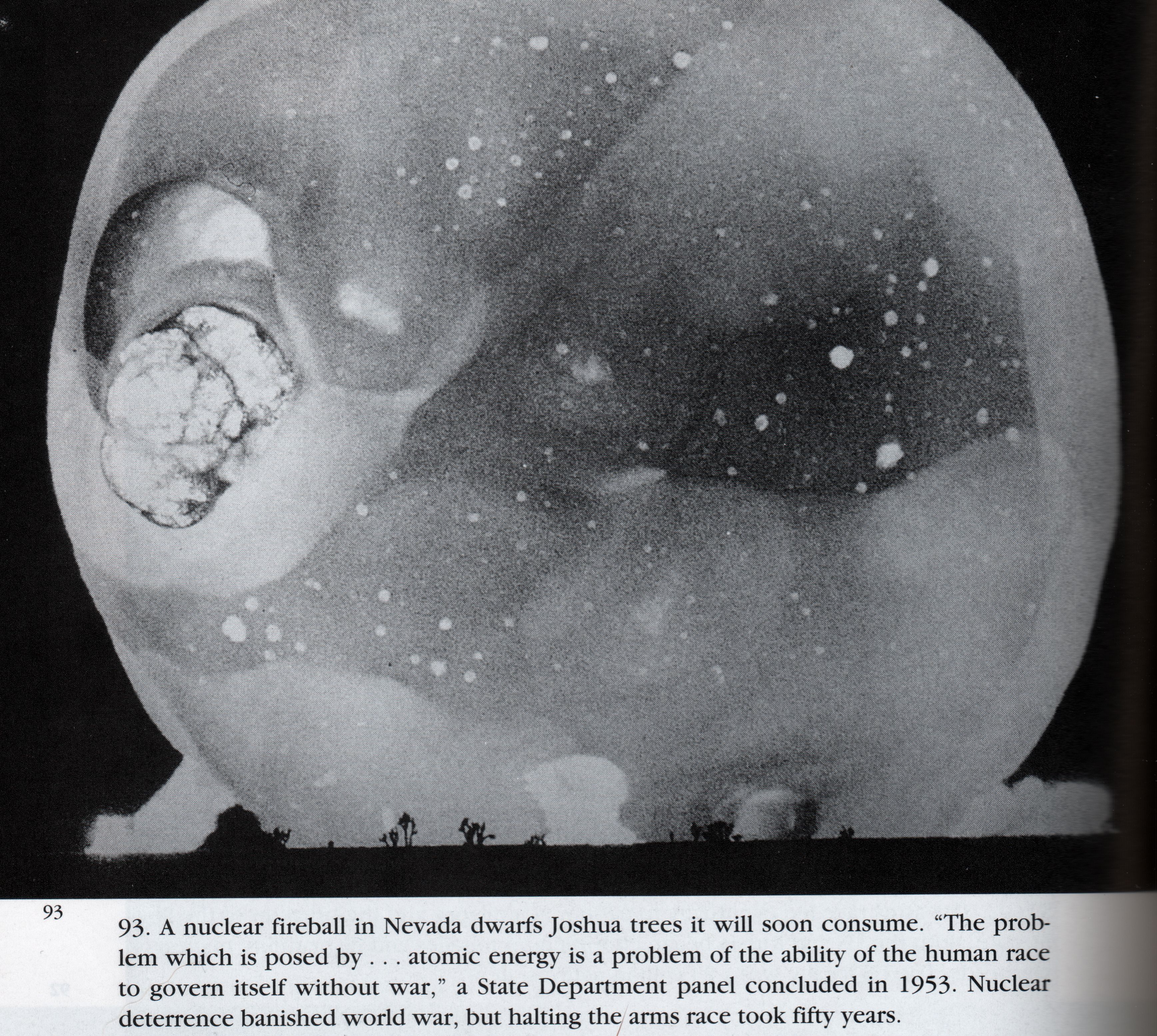
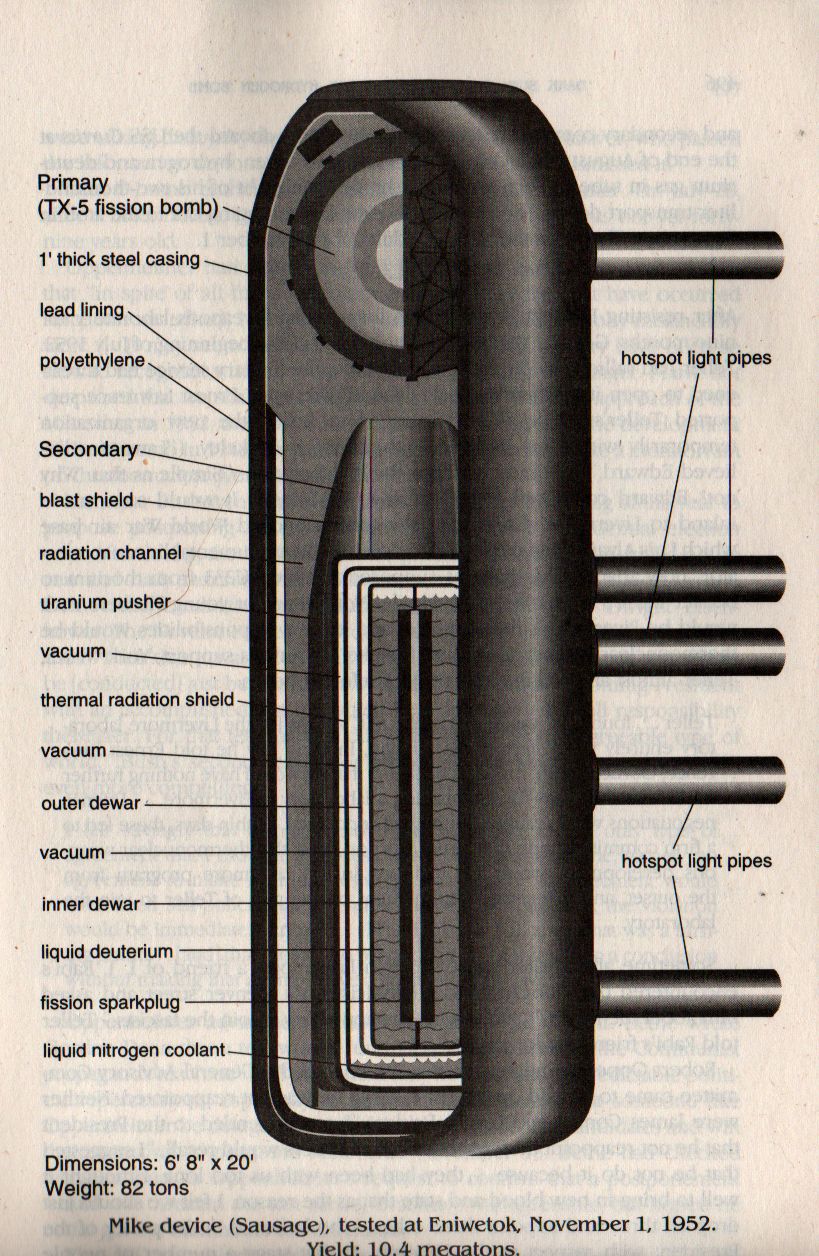
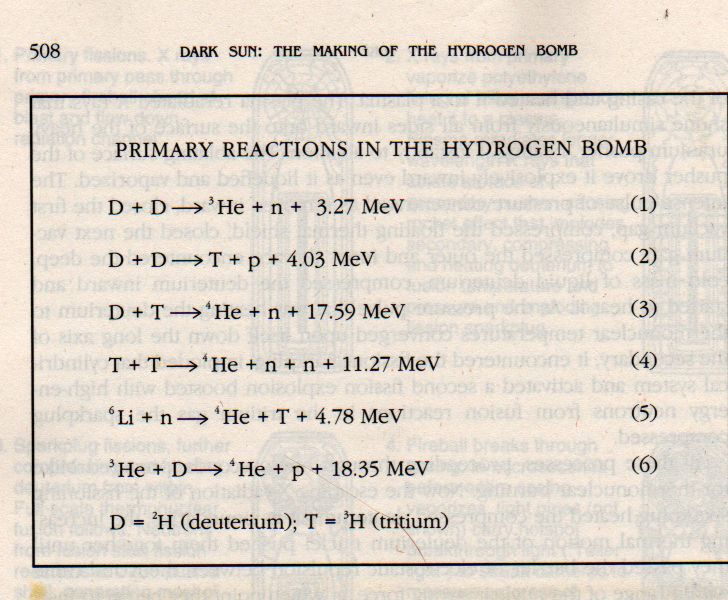
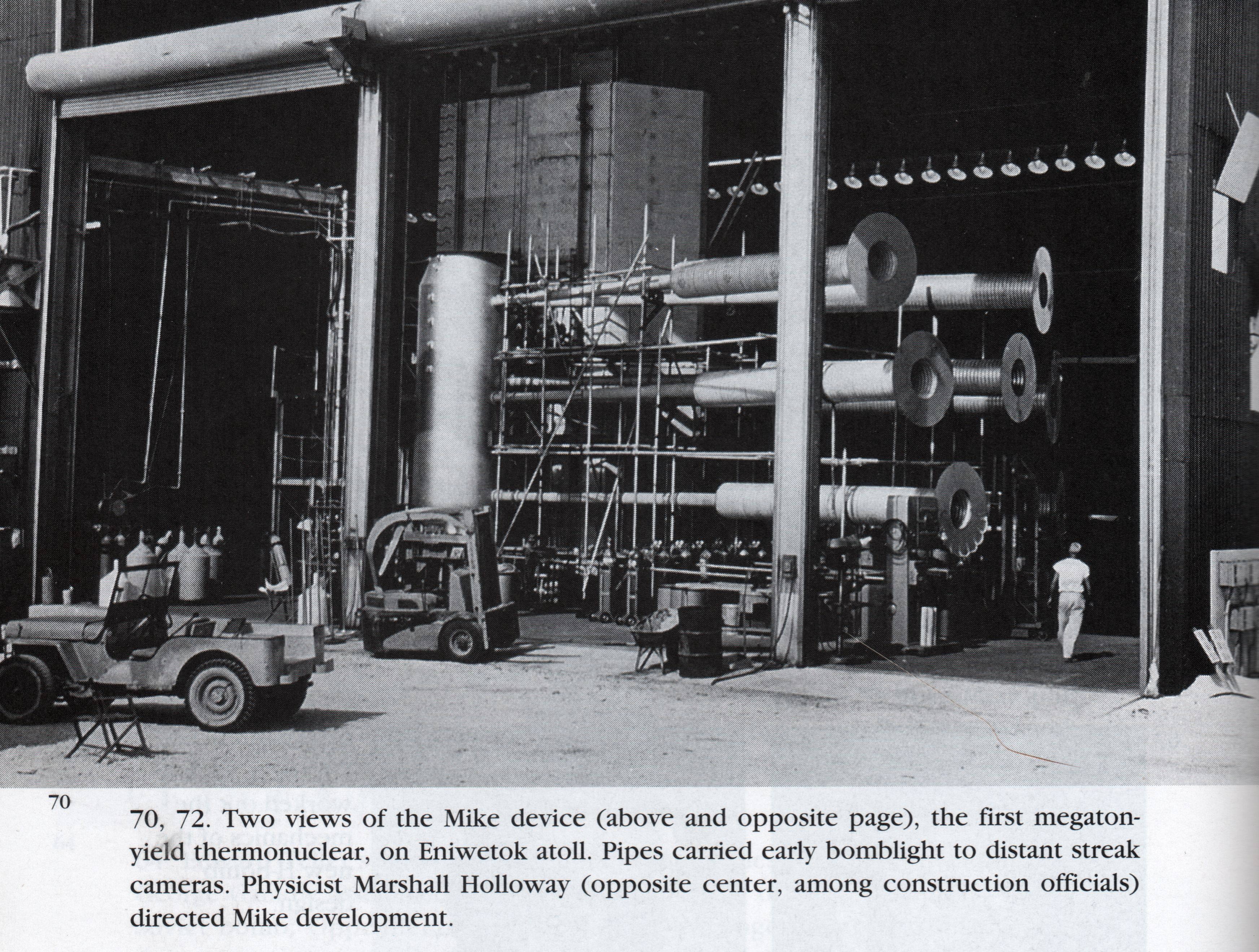
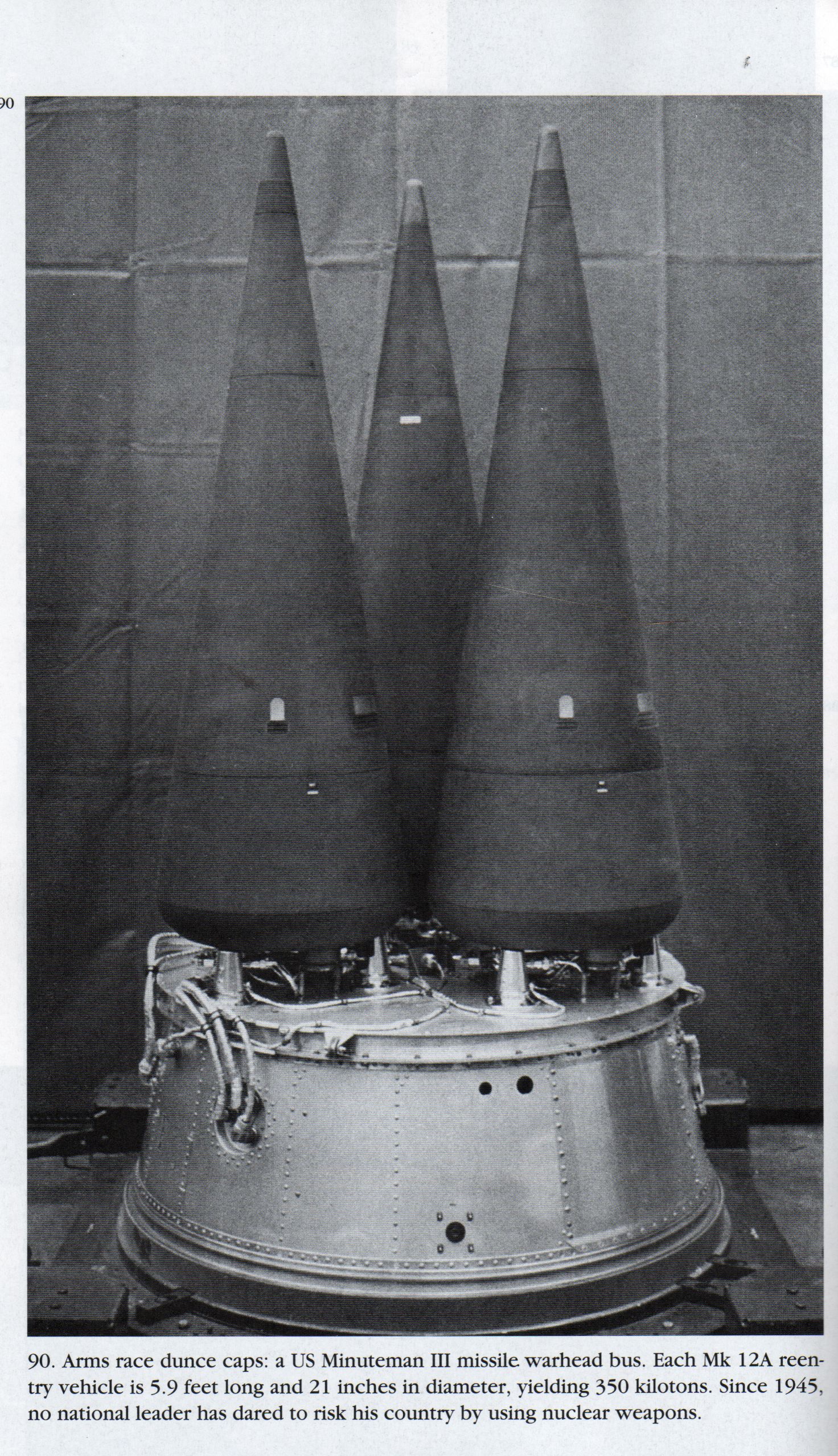
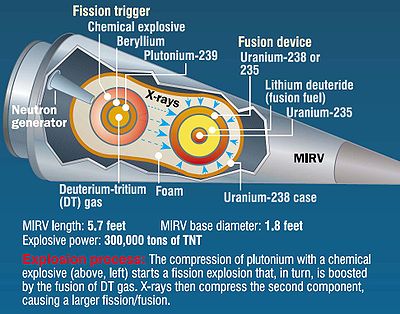
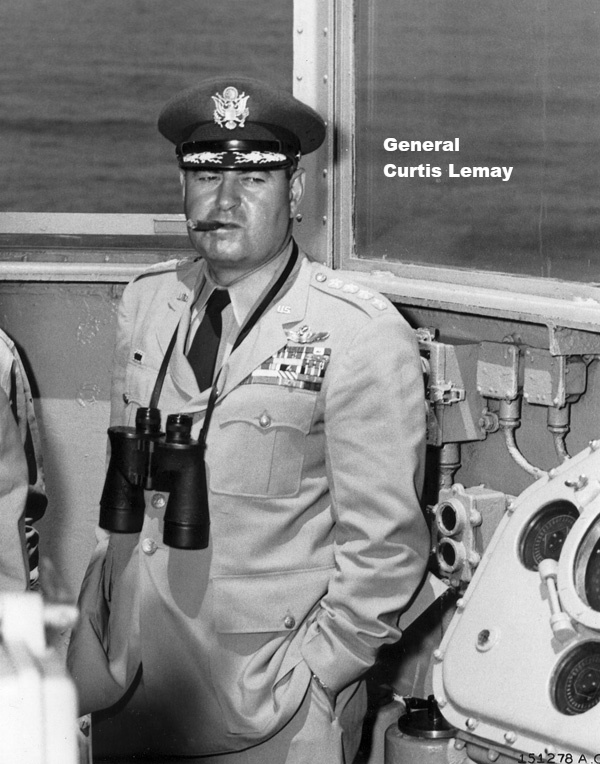
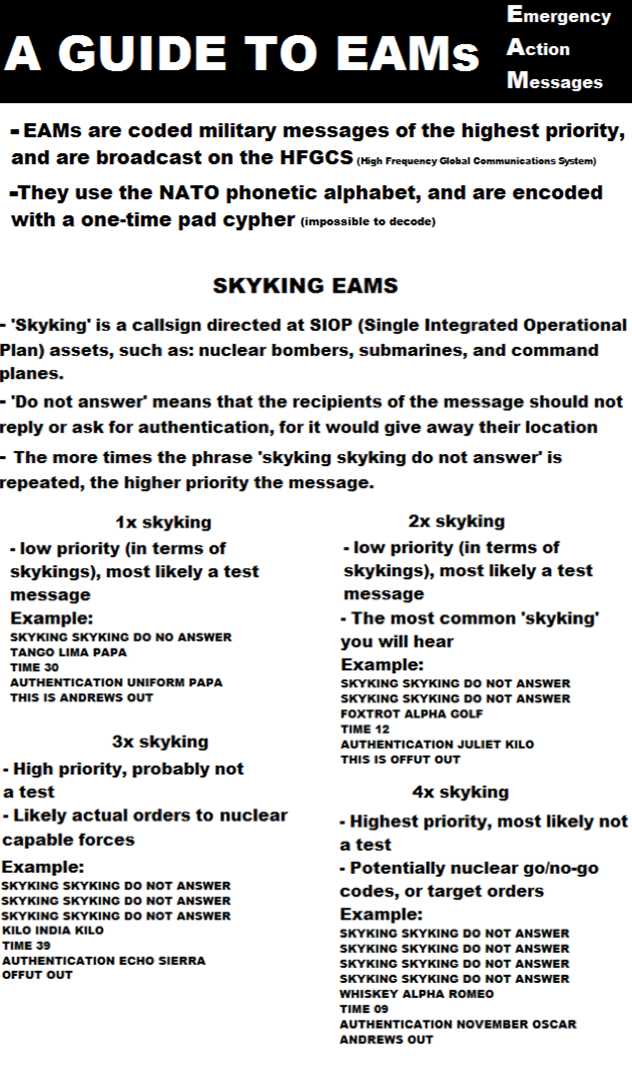
| Arsenals of Folly | ||||||||||||
|---|---|---|---|---|---|---|---|---|---|---|---|---|
|
The first US thermonuclear test, Ivy Mike was conducted in November, 1952.
The first Soviet thermonuclear test in August, 1953, Britain in 1957, China
in June 1967, and France in June, 1968.
The war of the future would be one in which man could extinquish millions of lives at one blow, demolish great cities of the world, wipe out the cultural achievements of the past and destroy the very structure of a civilization that has been slowly and painfully built up through hundreds of generations. Such a war is not possible policy for rational men. In an oral history of U.S. strategic nuclear policy produced by the Sandia National Laboratories, the historian Douglas Lawson of Sandia comments that the large growth that we saw in nuclear weapons production in the 1950s and 1960s was primarily driven by the capacity of the production complex and not truly by military requirements. In a briefing at SAC headquarters in Omaha, Nebraska in 1954, SAC had then identified some 1,700 enemy designated ground zeros (DGZs) which included 409 airfields. At the time, SAC had 2,400 ready flight crews, a mix of medium and long range bombers including the huge B-37 with a range of 8,000 miles, the smaller but jet powered and aerial-refueled B-47, and B-52s coming on line with an aerial-refueled range of 9,000 miles. By 1960, the US arsenal had increased to 18,639 bombs and warheads yielding 20,500 megatons (1.4 million Hiroshimas) of which 3,127 were strategic weapons deployed on B-47 and B-52 bombers, large first generation Atlas and Titan liquid fueled ballistic missles and Polaris nuclear submarines. SAC favored massive 10-25 megaton behemoths to maximize its delivery capacity. Making a weapon twice as accurate allows an eightfold reduction in yield while achieving the same level of destruction. Targetting atomic bombs and hydrogen bombs as if they were precision weapons is something like using a large meteor to drive a nail, and it depopulates the target zone. Nuclear weapons cost the US about $250,000 each (excluding shipping and handling costs), less than a fighter bomber, less than a missle, less than a patrol boat, less than a tank. Each one can destroy a city and kill hundreds of thousands of people. You can't have this kind of war. There just aren't enough bulldozers to scrape the bodies off the streets. We are in an entirely new situation that cannot be resolved by war. The impossibility of resolving militarily the new situation that knowledge of how to release energy imposes on the world is the reason the efforts on both sides look so desperate and irrational; They are built on what philosophy calls a category mistake, an assumption that nuclear explosives are military weapons in any meaningful sense of the term, and that a sufficient quantity of such weapons can make us secure. They are not, and they cannot not. The ongoing SALT talks were a key battleground and Henry Kissinger a primary target. At a press conference in Moscow in July, 1974, confronted about giving away nuclear superiority after the talks had stalled, Kissinger had responded in exasperation "One of the questions which we have to ask ourselves as a country is what in the name of God is strategic superiority? What is the significance of it, politically, militarily, operationally, at these levels of numbers? What do you with it? Telling the truth about the cynicism of the nuclear arms race was politically dangerous. Carter's Presidential Decree 59 (PD-59) was the decapitation policy that would use weapons to destroy key leadership cadres, their means of communications and some of the instruments of domestic control. The USSR with its gross overcentralization of authority epitomized by its vast bureaucracy in Moscow should be highly vulnerable to such an attack. The Soviet Union might cease to function if its security agency, the KGB were severely crippled. If the Moscow bureaucracy could be eliminated or isolated, the USSR might disintregrate into anarchy. Reagan attended a briefing on the Single Integrated Operational Plan (SIOP). The SIOP in 1983 had 5,000 decapitation targets and 50,000 other targets. The use of any weapon, kinetic or non-kinetic, must comply with the key principles of [the Law of Armed Conflict]: military necessity, avoidance of unnecessary suffering, proportionality, and discrimination or distinction,
Carl Sagan estimated in 1992 that the Cold War costs about $10 trillion and wrote an indignant benediction that this was "enough to buy everything in the US except the land". What we bought for a waste of treasure unprecented in human history was not peace nor even safety but a pervasive decline in the capacity and clemency of American life." The dollars that pay for the operation of the military system finally represents something forgone from other aspects of our life., especially those parts that are dependent of financing from the community's public budget. Which should be indisputable, since civil destitution is exactly what happened to the Soviet Union. |
||||||||||||
| Atomic Audit | ||||||||||||
|
Visualizing the Cost of Nuclear Weapons
Distributed evenly to everyone living in the United States at the start of 1998, the total estimated cost of nuclear weapons equals $21,646 per person. Represented as bricks of new $1 bills (such as one can obtain at a bank bound at $200 to the inch) stacked on top of one anothher, $5,821,027,000,000 would stretch 459,361 miles (739,117 kilometers), to the Moon and nearly back. If $1 was counted off every second, it would take almost 12 days to reach $1 million, nearly 32 years to reach $1 billion, 31,709 years to reach reach $1 trillion and about 184,579 years to tally the actual and anticipated costs of nuclear weapons. Laid end to end, bricks of $1 bills equivalent to the sum actually expended on U.S. nuclear weapons since 1940 ( $5,481,083,0000,000 ) would encircle the Earth at the equator almost 105 times, making a wall more than 8.7 feet (2.7 meters) high. The notion that nuclear weapons are less expensive than conventional ones can be traced to the fact that a given amount of fissile material (plutonium or highly enriched uranium, HEU), when fissioned in a nuclear bomb can produce more explosive power than an equivalent amount of conventional high explosives. Therefore the reasoning went, while 10 pounds of high explosives might kill or injure 100 people, 10 pounds of plutonium might kill or injure 100,000 people. Naturally occuring uranium is composed of almost 99.3 percent uranium-238 which is not suitable for nuclear explosives, and onlt 0.7 percent uranium-235, the fissionable isotope used in weapons. The level of uranium-235 must be increased or eenriched before it can be used in nuclear weapons or even in most common nuclear power reactors. Most nuclear power reactors use uranium fuel enriched to 2-5 percent but the U.S. nuclear program used HEU, defined as greater than 20 percent uranium-235 to manufacture warhead pits and secondaries for thermonuclear weapons, for naval reactor fuel and as fuel for some production reactors at its Savannah River site (SRS). All plutonium has to be produced in nuclear reactors. Plutonium is created when uranium-238 absorbs neutrons during a chain reaction. The uranium-238 forms the isotope uranium-239, which through a process called beta-decay quickly transforms into another element, neptunium-239. A second beta-decay than results in plutonium-239, the principle isotope used in weapons. Once the plutonium is produced, it is chemically separated from the spent reactor fuel in a procedure known as reprocessing. Of the many facilities that contributed nonnuclear components, only the Kansas City plant, near Kansas City, Missouri remains in operation. It supplies various electrical, electronic, and plastic components, including arming, fuzing, and firing systems, radars, and coded safety locks known as permissive action links (PALs). The most sensitive and dangerous procedure takes place in containment cells known as "Gravel Gerties", where high explosive chemicals are layered around the spherical nuclear explosive pits. Each Gravel gertie (there are thirteen in all at Pantex), holds some 17 feet (5.2 meters) of gravel on its roof and is designed to collapse should the chemical explosive detonate during the assembly process, thus containing the explosion and any radioactive debris it produces. At the end of World War II, the Manhattan project costs ($1.9 billion, or $21.6 billion in 1996 dollars) far exceeded the government's expectations.
Project Function          Then year dollars   1996 dollars
----------------          -----------------   ------------
Uranium enrichment        $1.2 billion        $13.6 billion
Plutonium production      $390 million        $ 4.5 billion
Weapons research/design   $ 143.7 million     $ 1.6 billion
Raw materials             $ 103.4 million     $ 1.2 billion
Official budget information suggests that the AEC, ERDA, and DOE have spent more than $165 billion to produced fissile and special materials for nuclear weapons, includingh and estimated 725 metric tons of HEU (estimated average enrichment of 93%), 103.5 metric tons of fuel and weapon grade plutonium and an estimated 225 kilograms of tritium since 1948. Tritium has a 12.3 year half life. Its use requires those weapons using it to be renewed periodically.
Trinity and Beyond Trinity, July 16, 1945, 0508, 15 kilotons
47 U.S. Code 606 - War powers of President PresidentiaL Emergency Action Documents (PEADS) You may reasonably expect a man to walk a tightrope safely for ten minutes; it would be unreasonable to do so without accident for two hundred years.
Nuclear war could alleviate some of the factors leading to today's
ecological disturbances that are due to current high population
concentrations and heavy industrial production.
"The unleashed power of the atom", Albert Einstein wrote in 1946, "has changed everything save our modes of thinking, and we thus drift toward unparalleled catastrophe." Winston Churchill noted in 1955, however, that nuclear deterrence might produce stability instead and predicted that "safety will be the sturdy child of terror, and survival the twin brother of annihilation." Einstein's view became the touchstone of the modern peace movement. Churchill's view evolved into mainstream Western nuclear strategy and doctrine. Both argued that the nuclear revolution had fundamentally transformed international politics. Both were wrong.
Safety Tips for the Post-Nuclear Existence
Atoms are made of extremely tiny particles called protons, neutrons, and electrons. Protons and neutrons are in the center of the atom, making up the nucleus. Along with neutrons, protons make up the nucleus, held together by the strong force. The proton is a baryon and is considered to be composed of two up quarks and one down quark. The charge on the proton and electron are exactly the same size but opposite. Along with protons, neutrons make up the nucleus, held together by the strong force. The neutron is a baryon and is considered to be composed of two down quarks and one up quark. A free neutron will decay with a half-life of about 10.3 minutes but it is stable if combined into a nucleus. The number of protons in an element's nucleus is called the atomic number. Protons, neutron & electrons.
Protons are made of two Up and one Down quark. The neutron is made of two Down and one Up quark. The Up quarks have a 2/3 positive charge and the Down has a 1/3 negative charge. Protons and neutrons each contain three quarks. A proton is composed of two 'Up' quarks and one 'Down' quark while neutrons are composed of one 'Up' quark and two 'Down' quarks. Nucleons and Quarks Neutrons and protons are made up of quarks, which are held together by Gluons. Since the number of protons in an atom does not change, fewer or extra electrons can create a special atom called an ion. Cations have fewer electrons and have a positive charge. Anions have extra electrons that create a negative charge. When two or more quarks are held together by the strong nuclear force, the particle formed is called a hadron.
An atom is 99.999999% empty. If atoms are mostly empty space, why do objects look solid? You have to understand that statement "atoms are mostly empty space" for what it actually means. You can't interpret it as "nothing is going on in 99.999999% of the volume of the atom." No experiment has ever established a definite lower bound on the radius of an electron. As far as we can tell, they are point particles. That's one fact that feeds into the "empty atoms" idea. The other is that if you take a stable atom and ask where the electrons are, what you get is a probability distribution that is significantly non-zero over some particular volume of space. This is the second fact that feeds into the "empty atoms" idea. Finally, we know from Rutherford's experiment that the atomic nucleus is very small compared to that "volume of influence" of the electrons. This is the third "empty atoms" fact. Putting facts one and three together, you get that a) the nucleus occupies a tiny volume, b) electrons have no radius at all as far as we can tell and therefore no volume, which leads to the notion of a very small amount of "occupied space" in an atom. But then the volume of influence of the electrons is much, much larger. The conclusion drawn is that atoms are mostly empty. But you also have to recognize that even though the electrons have no significant volume, they influence a significant volume. One of the aspects of that influence is that photons of visible light that pass near the atom - near any part of that "volume of influence" are likely to interact with the electrons of the atom. So light can't "pass through" the empty space of an atom. Not visible light at least - it's wavelength is long compared to the size of the atom. Perhaps EM radiation of much much shorter wavelength might zip through without interacting with the atom, but those aren't the wavelengths we see with. If light can't pass through something, it looks solid to us. All of the arguments made in the first couple of paragraphs above just don't matter for purposes of how light interacts with a material. A really sloppy way of saying this is to say that "the holes are too small to see." Radio telescopes use parabolic reflectors to concentrate the radio waves at a collector. But this reflector doesn't have to be solid. You can make it out of chicken wire, in fact. It works almost as well as a solid piece of metal would work. That chicken wire reflects radio waves just fine because the wavelength of the radio waves is long compared to the holes in the chicken wire. The radio wave reflects. But visible light shoots right through - you know you can see through chicken wire just fine. The situation with atoms and their empty space is entirely analogous - the wavelength of visible light is such that it can't just pass through materials that look solid.
|
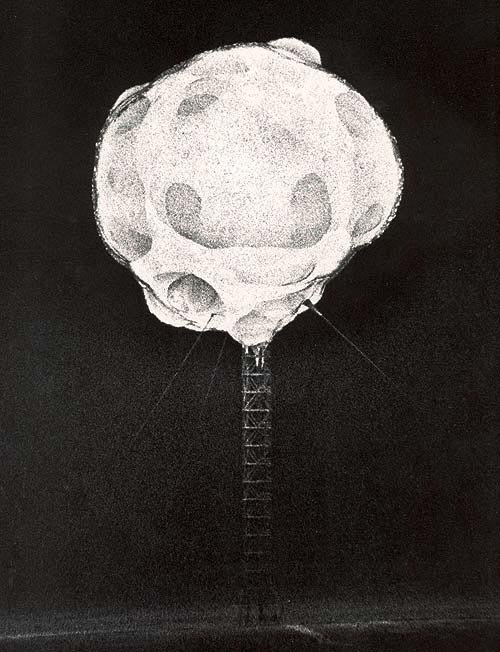
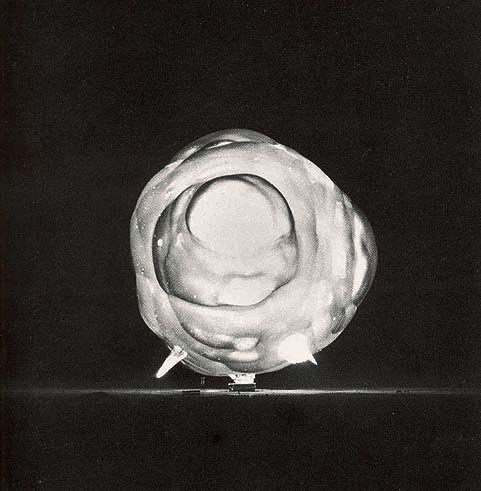
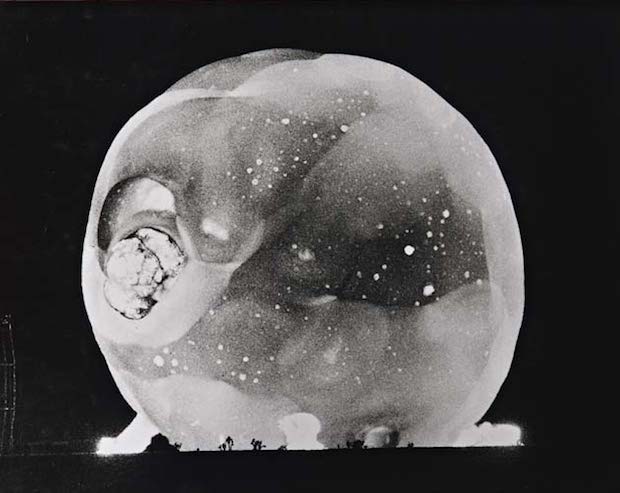
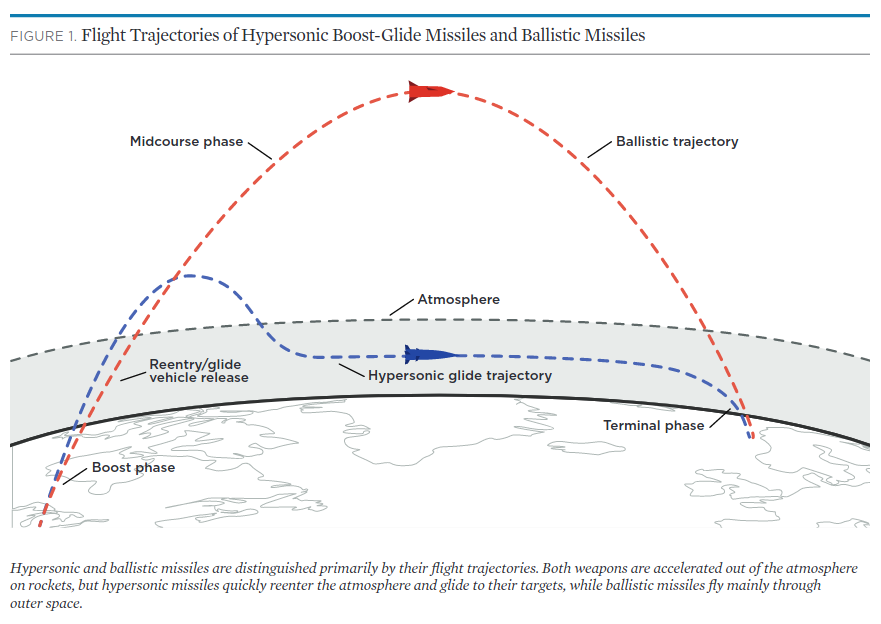
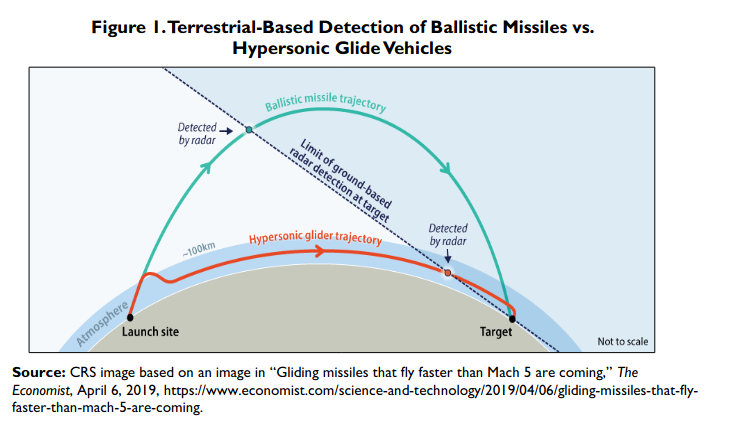

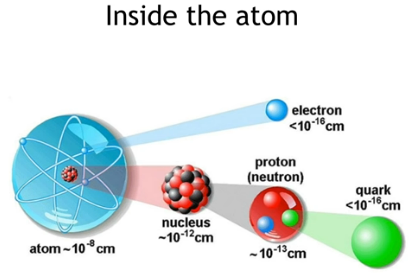
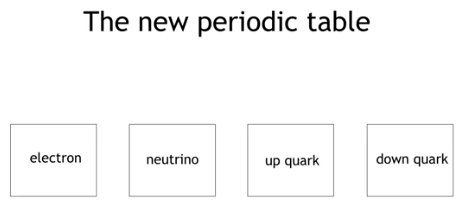
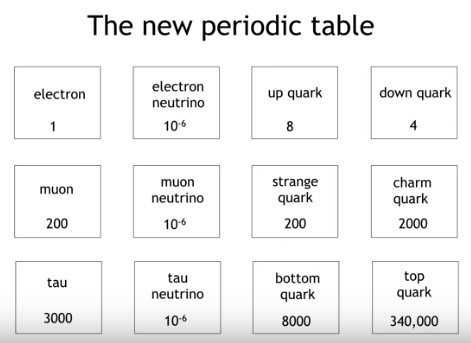
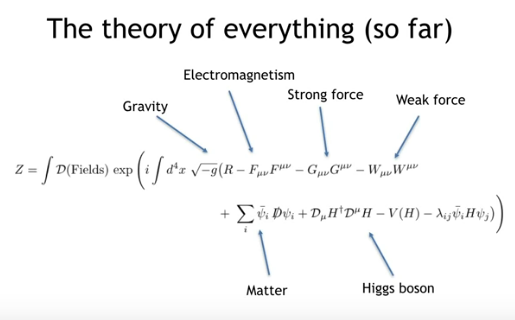
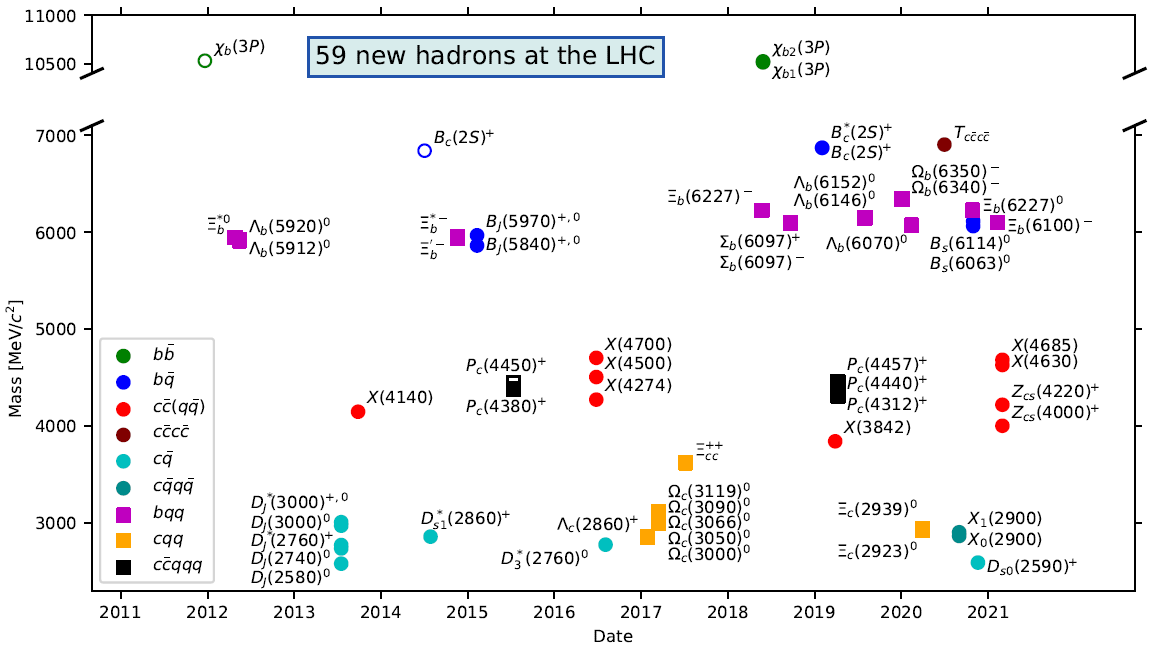
Send comments to:
 hjw2001@gmail.com
|
